Hadeeth: Allaah Cannot Accept the Charity of People Whose Relatives are in Need…

In the Name of Allaah…

I received a Hadith whose authenticity I  want to verify: The Messenger of Allah (sal Allahu alaihi wa sallam) said: “O Community of Muhammad! By the Being Who has sent me with Truth, Allah cannot accept the charity of those persons whose relatives are in want of his kindness and help, and he distributes it among others, leaving them. By the Being in Whose power is my life, on the Day of Judgement Allah will not look at such a man.” [Tibraani]

Dha’eef (weak) – It was collected by At-Tabaraanee [1], who mentioned that ‘Abdullaah ibn ‘Aamir al-Aslamee was alone in reporting it from az-Zuhree.  Al-Haythamee indexed it [2], saying: Continue reading

A Question About Allaah’s Names that Some Scholars Have Affirmed Using Texts that do not Have the “Al-” Prefix, Like “Al-Haleem”

In the Name of Allaah…

Regarding the book Exemplary Principles Concerning the Names and Attributes of Allaah, in the evidences section for Allaah’s Names, there may be names with ‘al’ before them, but in the evidence used for those names there is no ‘al’. For example, on page 246, Name #22,  it gives the name Al-Haleem but in the Aayah below that it says Haleemun (not al-Haleem). So is this something allowed, or is it that the name al-Haleem is established in another place in the Qur’aan or Sunnah ? Should I just trust the names of Allaah with ‘al’ at the beginning shown in the book, although the evidences used for those names dont always come with ‘al’? This is an important issue for me as I am worried about affirming a Name for Allaah that is not His Name.

Having “Al-” or not is not the only one consideration the scholars use for establishing a Name for Allaah. If it was only this then we would not be able to complete a list of 99 names, and our list would include other names like “At-Tabeeb” (the Doctor) and “Ad-Dahr” (The Time), which are unanimously (or almost unanimously) not considered to be from Allaah’s Beautiful Names.

So the scholars generally consider:

  • the meanings and general contexts of the textual evidence
  • idhaafah or lack of it (a kind of Arabic construction)
  • taqyeed or itlaaq (generality or limited restriction)
  • ishtiqaaq (derivitaves)
  • the “Al-” prefix

You can review these language issues with an Arabic teacher who has knowledge of the correct beliefs if you are not clear on them.

Specifically, with names like al-Haleem, al-Ilaah, and others are discussed, there is no Qur’aanic text referring to Allaah as Al-Haleem or Al-Ilaah, and I do not know of any hadeeth either.

Shaykh Ibn ‘Uthaymeen affirmed them both and others like them without relying on a text with “Al-”, since the context in both Qur’aanic passages was unrestricted, or ”mutlaq”. So the Verse meaning “Your ilaah (object of worship) is one ilaah, there is no ilaah other than Him…” and Verses like it were used to establish the name “Al-Ilaah”, and the Verse you mentioned for al-Haleem, and so on.

This is known to the scholars, since if you were to stick to only Names that come with only clear explicit Alif-Laam “Al-” prefix, then you would only gather about 40/50 or so names from the texts. And since the Messenger (sallallaahu alayhe wa sallam) encouraged us to seek after the 99 Names, then there must be another way to compile them than just relying only on “Al-”.  And then the scholars differed in their specific methods of deriving Allaah’s Names from the texts.

And Allaah knows best.

Written by: Moosaa Richardson

Did Prophet Adam Commit Shirk by Naming His Son Abdul-Haarith?

In the Name of Allaah, the Most Merciful…

Allaah, the Most High says, what means:

( He is the One who created you (all) from a single soul, and from it He created its mate, so he could dwell with her (harmoniously).  When he (Adam) covered her (Eve, in intimacy), she became pregnant, a light pregnancy (not difficult) that she went through.  When she got heavier, they called upon Allaah, their Lord, ‘If you give us a sound child we would surely be of the thankful.  And when He gave them sound offspring, they set up partners unto Him regarding what He had given them.  Exonerated is Allaah above the partners they ascribe to Him! ) [Soorah al-A'raaf, 7:189-190]

This Qur’aanic passage may seem to indicate that it was Adam and Eve that committed the act of shirk (setting up partners unto Allaah), especially when one reads the following report, with many similar wordings and meanings, which has been reported in the books of Tafseer:

When Hawwaa’ (Adam’s wife, Eve) became pregnant, Iblees came to her, after she had not had any offspring that had lived, saying: Name him Abdul-Haarith!  So she named him Abdul-Haarith and he lived.  And that is a kind of revelation (of misguidance) from Shaytaan and how he orders the people (with misguidance).

Other narrations mention that he threatened them, saying that he would make the baby deformed.

The great scholar of Hadeeth, Shaykh Muhammad Naasir ad-Deen al-Albaanee – may Allaah have Mercy on him – said:

Dha’eef (unauthentic) – It was collected by at-Tirmithee (2/181, Boolaaq), al-Haakim (2/545), Continue reading

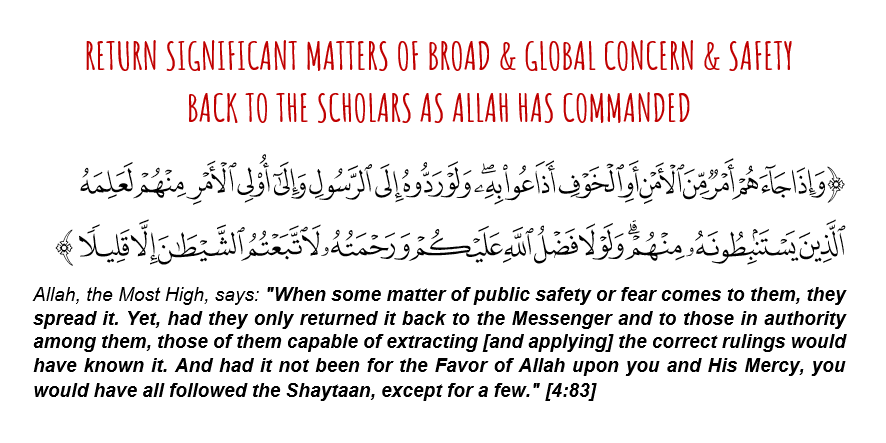
Firmly Grounded Scholars that Muslims Should Return to in Affairs of Differing

At the conclusion of one of his lectures explaining the Foundations of Eemaan as part of the Imaam Daar al-Hijrah Islaamic Seminar at Masjid al-Qiblatayn in al-Madeenah in 1432 [1], Shaykh Saalih As-Suhaymee (may Allaah preserve him) advised the students with a number of excellent points of advice in light of issues of differing that tend to distract them and keep them from benefitting from their studies.

While this great advice has been translated into English, and given the title, ”The Muslims are Tired,” perhaps the most important point in the lecture that Shaykh Saalih offered, after fearing Allaah and being sincere to Him alone, is the solution he guided the Muslims to – Returning to the senior scholars in affairs of differing. Continue reading

Who is Considered a “Strong Believer”?

In the Name of Allaah, the All-Merciful…

Imaam Muslim [d.261] (may Allaah have Mercy on him) collected an amazing hadeeth in his Chapter on Qadr in his large collection of authentic narrations known as Saheeh Muslim.  The scholars refer to this hadeeth as “the Hadeeth of the Strong Believer.”

On the authority of Aboo Hurayrah (may Allaah be pleased with him), the Prophet (sallallaahu ‘alayhe wa sallam) said:

المُؤْمِنُ القَوِيُّ خَيْرٌ وَأَحَبُّ إِلَى اللهِ مِنَ المُؤْمِنِ الضَّعِيفِ، وَفِي كُلٍّ خَيْرٌ، احْرِصْ عَلَى مَا يَنْفَعُكَ، وَاسْتَعِنْ بِاللهِ، وَلَا تَعْجِزْ، وَإِنْ أَصَابَكَ شَيْءٌ فَلَا تَقُلْ: لَوْ أَنِّي فَعَلْتُ كَانَ كَذَا وَكَذَا لَمْ يُصِبْنِي كَذَا، وَلَكِنْ قُلْ: قَدَرُ اللهِ وَمَا شَاءَ فَعَلَ، فَإِنَّ لَوْ تَفْتَحُ عَمَلَ الشَّيْطَانِ

“The strong believer is better and more beloved to Allaah than the weak believer, while there is (still) goodness in both. Guard over that which benefits you, seek Allaah’s Assistance, Continue reading

A Subtle Point of Benefit About Recordings of Classes

In the Name of Allaah…

Scenario:
A student actively attends an important lesson regularly, takes notes, and tries not to miss anything.  He gets there early to get a good seat to make sure he can hear clearly.  If someone asks him something in the lesson, he merely gestures for him to ask later.  His phone is always on silent, he pays no attention to it during the lesson.  Whatever people want from him, he will attend to it after the lesson.  He is focused on the lesson entirely.  He asks follow-up questions.

Another Scenario:
A student attends the same important lesson regularly, but he does not take notes.  He does not get there early, and so he sits in the back.  If someone asks him something in the lesson, he responds and helps.  He points out the direction of the bathroom… he may even explain who the shaykh is to a new student.  His phone is active, he occasionally answers calls or reads and responds to text messages.  Since he misses much of the content of the lesson, he does not ask follow-up questions.

If years go by and the student continues upon the path mentioned in the first scenario, then we have the makings of a serious student, maybe even a scholar eventually, and Allaah is the One who grants success.

If years go by and the student continues upon the path mentioned in the second scenario, then we have another brother who “studied”.

Would you believe that the two scenarios are describing the same student? Continue reading

List of Accepted Students at Imam University in Riyadh for the Spring Semester 2012

In the Name of Allaah…

Imam Muhammad ibn Saud Islamic University in Riyadh has just announced their list of accepted students for the second semester (Spring term) of the 2011-2012 school year.  The following names appear on the list of accepted students (names may be spelled phonetically, with more than one mistake):  

1.        

ادغوز الوف بختيار ابن غول آغا

ADGOZALOV BAKHTIYAR

P3388893

أذربيجاني

2.        

محمد خبيب عبدالذاكر

MOHAMMAD KHUBAID KHURSHID

ST009157

أفغاني

3.        

عبالحق حجييف ابن هاشم

HOJIEV ABDULHAK

02006447

أوزبكي

4.        

محمد رفاقت محمدى

MUHAMMADI MUHAMMD RAFAQAT

PH0158091 Continue reading

Biography: Shaykh Saalih ibn ‘Abdil-’Azeez Aal ash-Shaykh

In the Name of Allaah, the Most Merciful…

From a family of grounded knowledge, Shaykh Saalih ibn ‘Abdil-’Azeez Aal ash-Shaykh is the grandson of the great scholar, Shaykh Muhammad ibn Ibraaheem Aal ash-Shaykh (d.1389).  Shaykh Muhammad was the grandson of Shaykh ‘Abdur-Rahmaan ibn Hasan (d.1285), the author of Fat-hul-Majeed, an outstanding explanation of Kitaab at-Towheed of his grandfather, Shaykh al-Islaam Muhammad ibn ‘Abdil-Wahhaab (d.1206).  May Allaah have Mercy on all of them.

He was born and raised in Riyadh in 1378 (1958 on the Christian calendar).  He studied Quran Sciences at Imam Muhammad ibn Saud Islamic University, where his exceptional level of knowledge stood out, and thus he became a teacher there and taught for about 15 years. Continue reading

Kunyahs (Nicknames) for Men Based on Female Names

Is it against the Sunnah to have a kunyah (parental nickname) based on a female child’s name, like Aboo ‘Aa’ishah (the father of ‘Aa’ishah) or Umm ‘Aa’ishah (the mother of ‘Aa’ishah), because they are the parents of a girl named ‘Aa’ishah?  Someone told me that the Sunnah is to use male names only in kunyahs.

While male names were predominantly used in kunyahs, there is nothing against having a kunyah based on a female name, like Aboo ‘Aa’ishah.

A group of the Companions had kunyas like this, namely:

  • Uthmaan ibn ‘Affaan (Aboo Laylaa)
  • Aboo Hurayrah
  • Aboo Umaamah
  • Aboo Ad-Dardaa’  Continue reading

Three Points about Joking

In the Name of Allaah, the Most Merciful…

Let us be reminded that while light-hearted, honest joking from time to time is permissible, there are indeed dangers in joking that many of us may not think about and therefore fall into, so let us be warned about them:

1) JOKES INVOLVING LIES

Indeed the Prophet (sallallaahu ‘alayhe wa sallam) warned us severely against using lies in our joking, with his statement:

ويل للذي يحدث بالحديث ليضحك به القوم فيكذب، ويل له، ويل له
“Woe to the one who lies to make people laugh, WOE TO HIM, WOE TO HIM!” Continue reading

Q&A: A Hadeeth that Identifies Olive Oil as a Cure for Hemorrhoids?

In the Name of Allaah…

Can you tell me if the following hadeeth is authentic?  ‘Uqbah ibn ‘Aamir narrates that the Prophet (may Allaah raise his rank and grant him peace) said, “You have the olive oil from this Holy (mubaarak) tree, treat yourself with this, since it cures the Anal fissure (Basoor).”

This is not a hadeeth from the Prophet (may Allaah raise his rank and grant him peace).  Rather it is mowdhoo’ (fabricated, invented). Continue reading

Shaykh Ibn ‘Uthaymeen on Speaking Slang Arabic (‘Aammiyyah)

In the Name of Allaah…

Many non-Arabs who learn proper Arabic find difficulty in communicating with regular, everyday people.  The problem is that common Arabs don’t usually speak a very high level of fus-haa (proper) Arabic, rather they speak ‘Aammiyyah, a lesser grade of Arabic slang.  Students of the Arabic Language tend to have a strong stance against the use of this slang, ‘Aammiyyah

Perhaps the following words from the great scholar, Shaykh Muhammad ibn Saalih al-’Uthaymeen (may Allaah have Mercy on him), may provide some much needed insight into the issue: [1] Continue reading

The Ruling on the ‘Aqeeqah (Slaughtering for a Newborn)

In the Name of Allaah…

‘Aqeeqah: Slaughtering sheep after the birth of a newborn, two for a boy, one for a girl, preferably on the seventh day after the birth.

Ibn Qudaamah (d.620), may Allaah have Mercy on him, said:

“The ‘aqeeqah is a Sunnah (recommended deed) according to the vast majority of the scholars, like Ibn ‘Abbaas, Ibn ‘Umar, ‘Aa’ishah, the jurists of the taabi’oon (those who came after the companions), and the scholars of the various lands, with the exception of Ahlur-Ra’y (the Hanafees), who held that it was from the customs of Jaahliyyah (the pre-Islamic period of ignorance)… And Al-Hasan (al-Basree) and Daawood (ath-Thaahiree) held it to be an obligation…” [1] Continue reading

Biography: Shaykh ‘Abdur-Rahmaan ibn Naasir as-Sa’dee

In the Name of Allaah…

He was the shaykh, Aboo ‘Abdillaah, ‘Abdur-Rahmaan ibn Naasir ibn ‘Abdillaah ibn Naasir as-Sa’dee, from the tribe of Tameem.

He was born in the city of ‘Unayzah, in Saudi Arabia, on the 12th of Muharram, 1307.  He memorized the Qur’aan and mastered its recitation before reaching the age of 11.  He then engaged himself in seeking knowledge, studying with the scholars of his city and those who visited it. Continue reading

Biography: Shaykh Muhammad ibn ‘Umar ibn Saalim Baazmool

His kunyah: Aboo Maalik, also called: Aboo Munthir (both are names of his sons – may Allaah bless them, their siblings, and their parents).

His lineage: al-Kindee, from a Yemeni tribe, Kindah, with a rich history.

His position in Umm al-Quraa University: Among the highest ranking and most respected professors in the university, he teaches in higher studies, oversees MA and PhD research, and takes part in their criticism and defense.

Some of his teachers: He had significant contact with Shaykh al-Albaanee (may Allaah have Mercy on him) by phone. Continue reading

“All of My Ummah will be Excused, Except for Those who Make Their Sins Known” (13 Points of Benefit)

In the Name of Allaah, the Most Merciful…

Imaam al-Bukhaaree stated in his Saheeh (#6069), Book of Manners, Chapter: The Muslim’s Screening of Himself, with his chain to Aboo Hurayrah (may Allaah be pleased with him), who said: I heard the Messenger of Allaah (sallallaahu ‘alayhe wa sallam) saying:

“All of my ummah (nation of followers) will be excused, except for the mujaahireen (those who make their sins known).  And verily it is a kind of mujaaharah (exposing one’s sins) that a man does something (sinful) at night, and then in the morning, when Allaah has screened his sin for him, he says, ‘Hey So-and-So!  I did such-and-such last night…’  And the night passed with His Lord screening him, and he wakes up casting aside the screen of Allaah from himself.” Continue reading

Advice and Reminders for Responsible Website Administrators

In the Name of Allaah…

All praise is due to Allaah, and may He raise the rank of His Messenger…

The following advice will aid responsible administrators of Islamic websites in benefitting the people and avoiding harms and doubtful matters, in shaa’ Allaah

1) Present beneficial articles that help the Muslims understand their Religion with evidences and clear language. Continue reading

Free Yourself From the Hellfire 25% [?]

Can you please verify the following hadeeth?

“O Allah I call You to witness and I call the bearers of Your Throne Your angels and all Your creatures to witness that You are Allah and there is no god except You and that Muhammad is Your slave and messenger.” Continue reading

Inside Connections: The “Waasitah” System in Some of the Muslim Countries

In the Name of Allaah, the Most Merciful…

Muslims from the West may find difficulty in understanding and working under the systems of law in some of the Muslim countries, especially the “waasitah” system, wherein one relies on a person of status to act as a special connection, or intermediary, between himself and the authorities, to help him get a job, a visa for a relative, or any number of services or concessions.  Before taking a rash position on the illegality or corruption of such a system, Muslims should educate themselves about the topic.  Continue reading

Rational Discussion of Intercession and the Issue of the Dead Hearing

Can the dead hear, (I was under the impression they couldn’t)…?  Seeking waseela with saints (while acknowledging that Allah gives all)? I basicaly need to know what the view is on them… Continue reading

Adam Supplicated: “By the Haqq (Right, Status) of Muhammad…” [?]

In the Name of Allaah, the Ever Merciful…

The following hadeeth is being spread on the internet:

“When Aadam had made his mistake, he said: O my Lord!  I ask you by the right/status of Muhammad that you forgive me.  He (Allaah) said: “And how did you come to know Muhammad?”  He said: When you had created me with your Hand and blown into me from your Rooh, I raised my head and saw that it was written on the bases of the throne: Laa ilaaha ill-Allaah, Muhammadur-Rasool Allaah.  So I knew that you would not place a name along with yours unless that was (the name of) your most beloved creation.  He (Allaah) said: “You have spoken truthfully, O Aadam, and had it not been for Muhammad, I would not have created you.” Continue reading

Studying Islam Overseas in Saudi Arabia’s Universities

In the Name of Allaah, the Most-Merciful, may His Salaah and Salaam be upon His final Messenger Muhammad, to proceed:

Bakkah.net features exclusive pictures, applications, and inside information about studying Islam overseas in Saudi Universities. Saudi Arabia hosts a number of Islamic colleges and educational institutions that provide opportunities for non-Saudis to come and learn Islam abroad. Here is some introductory information about some Saudi Universities: Continue reading

Imam Muhammad bin Saud Islamic University, Riyadh, Saudi Arabia

In the Name of Allaah, the All-Merciful…

OVERVIEW

Al-Imaam Muhammad bin Su’ood Islaamic University (IMIU), or Imam University for short, opened with two colleges, the College of Arabic Studies and the College of Islaamic Law in 1953 in Riyadh. Since then, many colleges have been added, as well as branches in other cities. Similar to Al-Madeenah and Umm Al-Quraa, non-Arabic speakers have a chance to learn Arabic here from the beginning in an Arabic Language Institute designed specifically for them. They can then continue their studies in one of the colleges only if they qualify with at least an 80% level of achievement. Continue reading

The Islamic University of Madeenah, Saudi Arabia

In the Name of Allaah, the All-Merciful…

OVERVIEW

Located in the beloved city of our Messenger (sallallaahu ‘alayhe wa sallam), the Islaamic University of Al-Madeenah was founded by the government of Saudi Arabia by a royal decree in the year 1381, intending to spread the teachings of Islaam all over the world. Continue reading

Umm Al-Qura University, Makkah, Saudi Arabia

In the Name of Allaah, the Most-Merciful, may His Salaah and Salaam be upon His final Messenger Muhammad, to proceed:

OVERVIEW

The Arabic Language Institute at Umm al-Qura University in Makkah, Saudi ArabiaLocated in the most virtuous of cities, Umm al-Qura University in Makkah, Saudi Arabia offers a chance for non-Arabic speakers, male or female, to learn Arabic within a two-year intensive program. Upon completing the initial studies in the Arabic Language Institute with qualifying grades (80% average or higher), the student earns the opportunity to take an entrance exam apply to study in one of the colleges of Umm Al-Qura University. Continue reading

Daar al-Hadeeth al-Khayriyyah, Makkah, Saudi Arabia

In the Name of Allaah, the All-Merciful…

OVERVIEW

Daar Al-Hadeeth Al-Khayriyyah in Makkah, established in 1352 (around 1930 according to the Christian calendar), not only gives students in-depth understanding of the Sunnah and its sciences, it also includes studies in all areas of the Sharee’ah. The school consists of four departments: Elementary school level, middle school level, high school level, and college level. Continue reading

Victims of Backbiting – Take Comfort in the Wisdom of the Salaf

In the Name of Allaah, the Most Merciful, may His Salaah and Salaam be upon His last Messenger to all of mankind, to proceed…

It has been narrated that one of the great imaams of the early Salaf, ‘Abdur-Rahmaan ibn Mahdee [d.198] (may Allaah have Mercy on him), said:

لولا أني أكره أن يعصى الله لتمنيت أن لا يبقى أحد في المصر إلا اغتابني!  أي شيء أهنأ من حسنة يجدها الرجل في صحيفته لم يعمل بها؟ Continue reading

What is a Weak Hadeeth?

What does a “weak” hadeeth mean exactly? Do we not believe in it? Or do we have doubts about it with a possibility that it could’ve been reported from the Messenger of Allah (sallallaahu ‘alayhe wa sallam)? What are we supposed to think of a ‘weak’ hadith? Please explain in detail, in shaa’ Allah. Continue reading

Hajj Without a Tasreeh (Government Issued “Hajj Permit”)

In the Name of Allaah, the Most Merciful: May He raise the rank of His honest and noble Messenger, and grant him peace…

Speaking to students of Imam Muhammad ibn Su’ood University in Riyadh before the Hajj of 1429 (2008) the Muftee, Shaykh ‘Abdul-’Azeez Aal ash-Shaykh (may Allaah preserve him), answered a question about making Hajj without a tasreeh (“Hajj Pass” or “Hajj Permit”).  The following is Imam University’s official write-up of his words: Continue reading

Seeking Knowledge – What you Should Know Before you Go

Important advice for those who may undertake the role of the student of knowledge – those who want to leave behind their homeland, perhaps family, jobs, homes, college studies, or important positions in their communities. [1]

In the Name of Allaah, the Most-Merciful, may His Salaah and Salaam be upon His final Messenger Muhammad, to proceed:

Verily from the most rewarding ventures a person can undertake is to pursue knowledge of Allaah’s Deen. The ones who are favored with understanding of the Religion, not only does Allaah want good for them, Continue reading

Clarifying the Difference Between a Wasiyyah (Bequethal) and Irth (Inheritance)

In the Name of Allaah, the Possessor of Infinite Mercy, the Justly Merciful…

Allaah says: [1] 

( After (the distribution of) a wasiyyah (bequethal) that was intended, or a debt (owed) )
In this verse, Allaah lays down the legislation for how irth (inheritance) is to be distributed.  Then, He legislates that the irth is to be distributed after any wasiyyahs (bequethals) or debts.  In the next verse as well, Allaah repeats this same distinction three more times. Continue reading

Can We Write “SAW” or “PBUH” When we Mention the Prophet and Messenger of Allah?

Originally published: 06-06-1423 [1]

In the Name of Allaah, may the Salaah and Salaam of Allaah be upon His Final Messenger, to proceed:

Muslims are obliged to send Allaah’s Salaah [2] and Salaam [3] upon Muhammad (sallallaahu ‘alayhe wa sallam) when his name is mentioned. Allaah has commanded us [4]:

( Verily Allaah and His Angels send salaah on the Prophet. O you who believe! Invoke salaah upon him, as well as a complete salaam! ) Continue reading

Regarding What to Say When You Sneeze

I recently mentioned the three ways to praise Allaah after sneezing, according to the narrations that have come from the Messenger of Allaah (sallallaahu ‘alayhe wa sallam), which are:

الحَمْدُ للهِ
“All praises are due to Allaah.” Continue reading

Guidelines in Understanding Texts that Warn of Severe Punishments

In the Name of Allaah, the Most Merciful…

This article clarifies the understanding of Ahlus-Sunnah regarding important religious texts on the issue of disbelief and the negation of faith, like the following hadeeths:

1) “Insulting a Muslim is fusooq (sinful disobedience), and fighting him is kufr.”

2) “None of you has eemaan until he loves for his brother what he loves for himself.”

3) “The qattaat (tale-carrier) shall not enter Paradise.”

4) “Whoever deceives us is not from us.”

And like the Quranic verse of the murderer (4:93) abiding in the Hellfire, and all other texts threatening of severe punishment for sins that other texts prove do not remove a person from the fold of Islaam. Continue reading

Why Are We Here?

In the Name of the Almighty God of the universe, the All-Merciful, the One who created the heavens and the earth and everything in them, the only One who deserves mankind’s worship…

A simple look at the world around us is all it takes to understand what many never take time to reflect upon. The details of this awesome universe we live in undeniably prove the presence of a magnificent and unequalled author. Continue reading