Shaykh Rabee’ on Students Assessing Their Own Levels of Understanding

In the Name of Allah, the Most Gracious the Ever Merciful…

The great scholar, al-‘Allaamah Rabee’ ibn Haadee al-Madkhalee (may Allah have Mercy on him), was asked the following question:

Our shaykh, may Allah preserve you, I have learned much from one of the students of knowledge, and I have become precise in that [which I learned]. Now I am between two things: If I hide that [which I learned], I fear that I would be from those who hide knowledge. If I teach it to the people in the masjid, I fear that I would be from those who teach people without having reached the [necessary] level of scholarship. What do you advise me to do? May Allah preserve you.

He replied, as found in his book, Marhaban Yaa Taalib al-‘Ilm (pp.432-444), with the following detailed and highly beneficial reply:

By Allah, we did not attain precision ourselves! How can you say, “I have become precise in that,” whilst you are still young? That would be a serious level [of accomplishment]. Do not say, “I have become proficient,” as I fear it might be self-delusion. No one should claim that he is precise. Instead, say: “I have learned something, and I want to teach it to those who need this knowledge.” Or, “I have learned the Three Principles and understood all of it.” Now go teach it to others, and make your intention sincere for Allah as it relates to this knowledge. You have learned Kitaab at-Towheed or ‘Umdat al-Ahkaam and understood it, so teach what you can, within the limits of your knowledge. Do not go into something beyond your ability. If you do not understand a question posed to you, then say, “Allah knows best.” Do not say anything on behalf of Allah without knowledge, since that is a serious matter! Continue reading →
NEW PUBLICATION: Manners of Islamic Knowledge (Official Workbook)

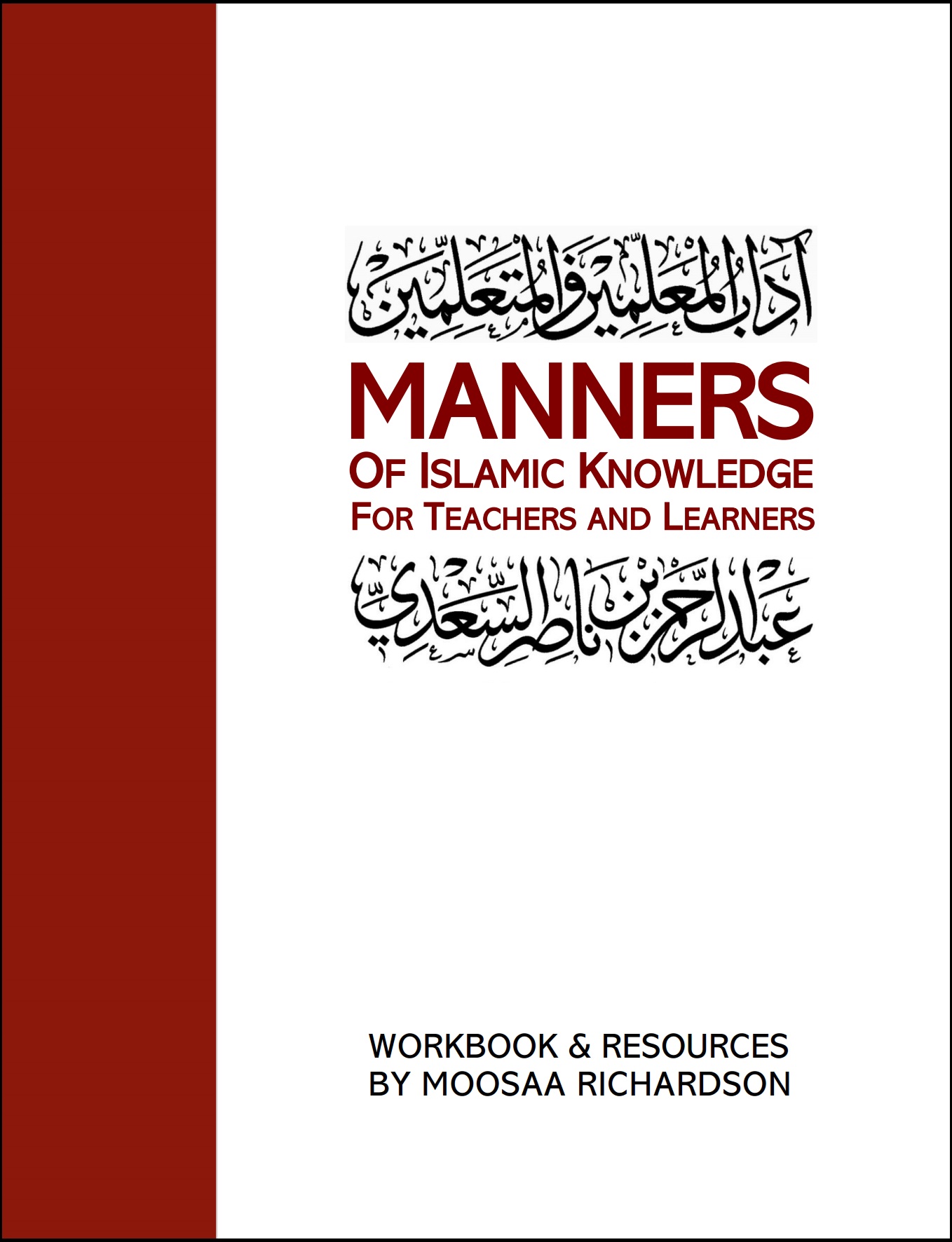
Al-hamdu lillaah, we are pleased to announce that our latest publication is now available -by the Permission of Allah-, Manners of Islamic Knowledge for Teachers and Learners: Workbook & Resources for Your Study of al-Imaam as-Sa’dee’s Aadaab al-Mu’allimeen wal-Muta’allimeen

*This article features affiliate links, through which we may earn a small commission which helps maintain our website and da’wah activities, so we thank you, jazaakum Allahu khayran!

BRIEF OVERVIEW:

  • Summary: 21 major points of essential manners needed by teachers and students alike, from the insightful scholarly writings of al-Imaam ‘Abdur-Rahmaan ibn Naasir as-Sa’dee (may Allah have Mercy on him).
  • In this workbook, you have the entire Arabic text of the book, paired with a clear English translation, laid out with ample space for notetaking during classes. After the text there are other helpful resources, including the uninterrupted text, in its original Arabic (both voweled and unvoweled), as well as its uninterrupted English translation.
  • Available resources: MP3 recordings | Free PDF Version
  • Printed Workbook on Amazon (affiliate links):*
  • Mobile versions of the text only: ( ENGLISH – عربي ) [for viewing on your phone specifically, large clear font, no space for note taking] coming soon, in shaa’ Allah
  • Sample pages:

Continue reading →

Important Advice from Shaykh Ibn Baaz About Nameemah

In the Name of Allah, the Most Gracious, the Ever Merciful…

The great scholar, Shaykh ‘Abdul-‘Azeez ibn Baaz (may Allah have Mercy on him), stated:

From what is necessary to avoid, be distant from, and warn against is nameemah, which is narrating [negative] speech from one person to another, one group to another, or one tribe to another, with the intention of causing corruption or clashes between them.

It [nameemah] is to expose what is disliked to be known, whether the one being quoted is the one who dislikes it, or the one being informed, or even if some third party dislikes it. It does not matter whether it is exposed verbally, in writing, or by gestures and signals. It does not matter whether words or actions are reported. It does not matter if that [report] is about someone’s [actual] faults or deficiencies, or not. A person must remain silent about all things he sees from the situations of people, except when sharing such a thing would benefit some Muslim or repel some harm.

What causes nameemah is either ill-intent for the one he speaks about or an attempt to show affinity for the person he shares with, or maybe just indulging in idle conversation, chatting away about useless things or falsehood. All of that is Continue reading →

Important Advice From Shaykh ‘Arafat al-Muhammadi

Stated Shaykh ‘Arafat bin Hassan al-Muhammadi (may Allah preserve him), one of the scholars recommended by Shaykh ‘Ubayd al-Jaabiree shortly before his passing (may Allah have Mercy on him):

We eat, drink, sleep, relax, we read and listen, but despite that there is weakness in us, a lack of action, a lack of remembrance, a lack of supererogatory prayer, night prayer, mid-morning prayer, and other than that from the supererogatory acts of worship.

Among us there is a wastage of time, and a creation of problems between us because of spare time – because we have spare time we end up becoming involved in problems and issues, we stir up problems between us. If you were preoccupied with memorisation of the Qur-ān and its recitation, and memorisation of the Sunnah and lessons, you would not have spare time for gossip.

As for the knowledge of appraisal and disparagement then this field has its men from ahlus-Sunnah, and the students are behind their scholars. However, we have begun delving into matters that do not benefit, matters that are actually harmful, that are causes of splitting occurring. If you know that this particular matter – a matter from the affairs of the world, some statement or action – you know it upsets your brother and is a cause of placing your brother into a difficult situation, and discomforting him, then why do you do it! Why do you do it? Why do you engage in it? Stay away from everything that is a cause for splitting and separating, and likewise from that which causes pain to your brother, or is a reason for causing him pain…

Read the full article here: PDF

Translation by: Shaykh Taqweem Aslam Abu Muadh (may Allah reward him well)

Arabic source: MP3

May Allah bless and reward both Shaykh ‘Arafat and the translator. This is beautiful advice, and I ask Allah to allow it to reach our hearts! This entire passage reminds me of the beautiful admonitions we would hear so often from our beloved shaykh, al-‘Allaamah Rabee’ ibn Haadee al-Madkhalee (may Allah preserve him). –Moosaa Richardson

10 FAQs About Studying at Umm al-Qura University in Makkah, Saudi Arabia

In the Name of Allaah, the All-Merciful, may His Salaah and Salaam be upon His final Messenger Muhammad, to proceed…

The following frequently asked questions are answered in this article:

  • I’m over 25 years old. Is it possible for me to be accepted?
  • How can they put an age limit on seeking Islaamic knowledge!?
  • I have a family and I would want them to live with me during my studies. Is that possible?
  • What is the difference between Umm Al-Quraa University and the Islamic University of Al-Madeenah?
  • I heard that Umm Al-Qura University does not allow non-Saudi students into any of the colleges. Is that true?
  • What is the best way to submit an application?
  • Is it a must to include pictures in my application?
  • Can women study at Umm Al-Qura University?
  • As a female student, can I bring my uncle or grandfather to live with me in Makkah to fulfill the condition of having a male relative with me?
  • Can you please give me special consideration for acceptance? Continue reading →

Seeking Knowledge – What you Should Know Before you Go

Important advice for those who may undertake the role of the student of knowledge – those who want to leave behind their homeland, perhaps family, jobs, homes, college studies, or important positions in their communities. [1]

In the Name of Allaah, the Most-Merciful, may His Salaah and Salaam be upon His final Messenger Muhammad, to proceed:

Verily from the most rewarding ventures a person can undertake is to pursue knowledge of Allaah’s Deen. The ones who are favored with understanding of the Religion, not only does Allaah want good for them, Continue reading →