
In the Name of Allah, the Most Gracious, the Ever Merciful…
This page is a collection of helpful resources for those who are studying the text, Nawaaqidh al-Islam (Things That Nullify Someone’s Islam), by Shaykh al-Islam Muhammad ibn ‘Abdil-Wahhaab (may Allah have Mercy on him).
*This article features affiliate links, through which we may earn a small commission which helps maintain our website and da’wah activities, so we thank you, jazaakum Allahu khayran!
VIDEO RECORDINGS of recent classes on this book: https://www.patreon.com/collection/794379
HIGH-QUALITY MP3 AUDIO RECORDINGS: https://www.spreaker.com/podcast/things-that-nullify-someone-s-islam–1667061
BUNDLE: Digital Resource Pack:
- MP3 recording of the text (Arabic only)
- MP3 recording of the text (English only)
- MP3 recording of the text (Arabic & English)
- PDF of the text (Arabic only, fully vowelled)
- PDF of the translation of the text (English only)
Get this entire bundle of high-quality digital resources here: https://payhip.com/b/ZG4M7
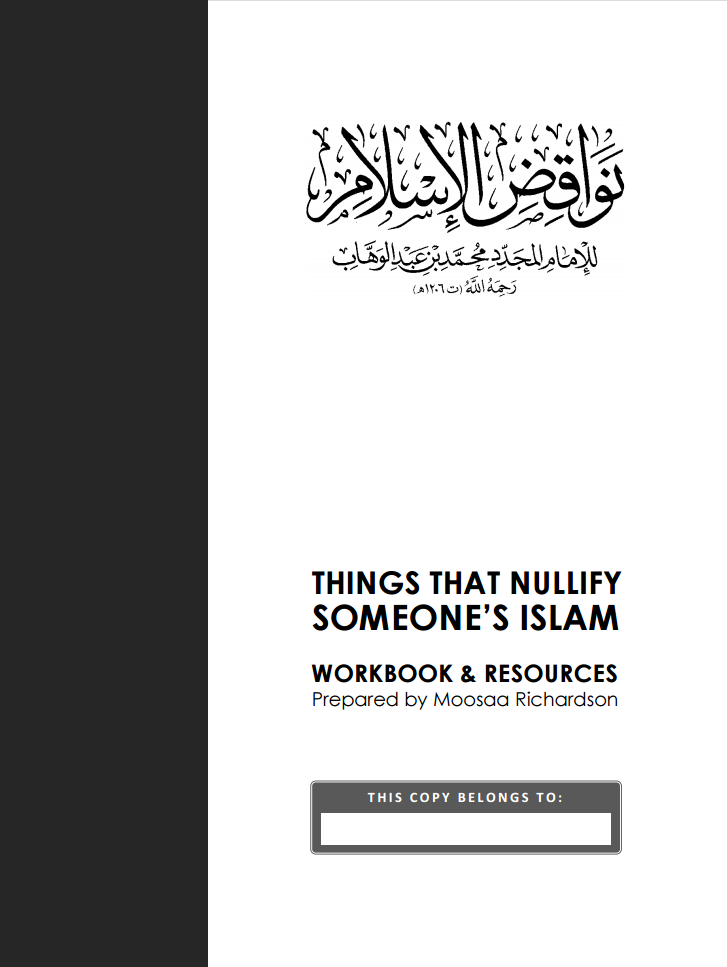
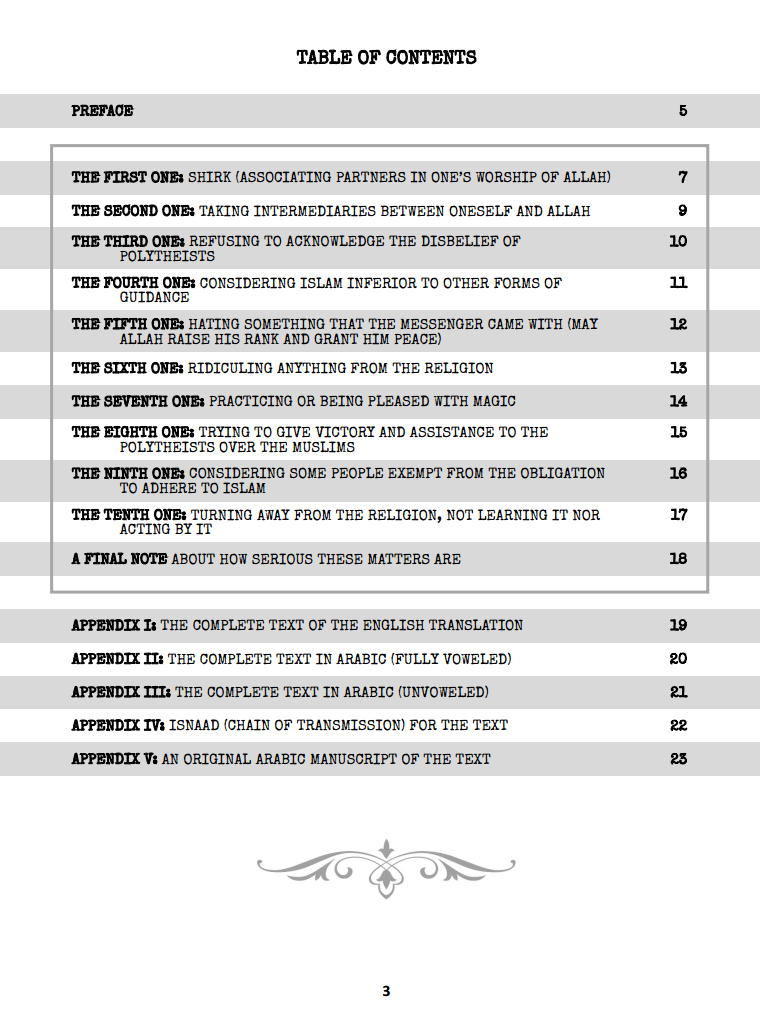
WORKBOOK: Things That Nullify Someone’s Islam (23 pages)
- Introduction by Moosaa Richardson
- Full text in Arabic and English, with space for note-taking
- Uninterrupted Arabic text (both vowelled and unvowelled)
- Isnaad (Chain of Transmission)
- Authentic Arabic Manuscript
Get the paperback version of the workbook from Amazon (affiliate links):
Get the PDF version of the workbook here: https://payhip.com/b/lZcpr
Get the mobile version of the text (Arabic): https://payhip.com/b/cqzbB
Get the mobile version of the English translation: https://payhip.com/b/4Kdkb
*This article features affiliate links, through which we may earn a small commission which helps maintain our website and da’wah activities, so we thank you, jazaakum Allahu khayran!
Assalamu alaikum wa rahmatullahi wa barakatuh, do you have information regarding a trustworthy Raqi in the north east US?
Barakallah feek for your help
Wa ‘alaykum as-Salaamu wa rahmatullaah wa barakaatuh. The Muslim upon towheed who has weakness, pain, or impairment reads anything that is easy from the Book of Allah, which is healing and mercy for all believers (see: 17:82), over the place of his ailment. He supplicates with supplications of towheed to Allah alone, with sincerity and conviction that he is calling upon One who is All-Capable and All-Hearing. This is easy; it is from Allah’s religion of ease. “The Deen is easy; no one makes things difficult in the religion except that it overwhelms him.” (Meaning of a hadeeth in Saheeh al-Bukhaaree). From Allah’s legislated ways of ruqyah through which any Muslim seeks healing and recovery from Allah. If the afflicted person cannot do this himself, then one of his close family members does it until he is capable of doing it himself. The culture of (assumed) healers and specialists which are sought out and depended upon is very dangerous to our towheed. Teachers of towheed and callers to towheed who are sincere and knowledgeable teach people to do this, and they do not contribute to any culture which causes people to rely upon the people, instead of Allah. Our job as callers to the religion is to connect the people to Allah, the Lord of the creation, as His worshippers. And Allah knows best.
There has become a common statement specifically said on Arab twitter by the ignorant:
“I am with anyone who is against Israel (Zionists), even if Iblees is against Israel then I am with Iblees!”
And I have even read from one of them “If Fir’awn was against Israel I would be with Fir’awn!”
What is your view on this statement
These seem like emotional statements, not statements guided by knowledge and wisdom. And Allah knows best. If you know someone who speaks like this, ask them to focus on what is beneficial, like real solutions to real situations, supplications for the oppressed, supplications against the oppressors, asking the people of knowledge about these affairs and learning the rulings, financial assistance given to those in need, genuine repentance and devotion in worship, etc. Solutions are not attained by filling the world with emotional outbursts.
Assalamu Alaykum wa rahmatullah.
What is the best response when someone in public attacks the religion in your presence due to you openly displaying the deen?
Is it best to ignore, it or is it better to respond in defense of the deen or by insulting their kufr. (This is in a non-muslim country with freedom of speech).
Wa ‘alaykum as-Salaamu wa rahmatullaah wa barakaatuh. This is a case-by-case issue. In some instances, perhaps silence and leaving the situation is the best (or least harmful) solution. In other situations, a detailed and emphatic response might be better. It also depends on the person’s level of knowledge and readiness to handle that specific situation. Our Messenger (may Allah raise his rank and grant him peace) employed both tactics, sometimes ignoring the ignorant rantings of the disbelievers, and sometimes confronting them. Harms and benefits are weighed. And Allah knows best.
السلام عليكم ورحمة الله وبركاته
The third nullifier of Islām:
“Whoever does not declare the polytheists to be disbelievers, or he doubts their disbelief or approves of their way, then he has disbelieved.”
As well, the Imām (رحمه الله) mentioned, “And with respect to these things that nullify one’s Islām, there is no difference between the one who did them in jest, the one who did them intentionally, and the one who did them out of fear, except for the one who was forced.”
Source of translated material:
https://www.troid.org/things-that-nullify-ones-islam/
So, the one who jokingly calls a kāfir whom he knows is a kāfir has committed kufr, undoubtedly. This is because they affirmed Islām for someone who is a kāfir, albeit jokingly. So, they fell into the third nullifier by not declaring a kāfir, a kāfir
If the one who commits this nullifier of Islām is not excused if they did what they did due to jest, does that mean they are a kāfir even if they were ignorant that joking like that is kufr?
وعليكم السلام ورحمة الله وبركاته
Specific rulings on individuals are applied by people who are knowledgeable about takfeer and its mawaani’ (impediments) and shuroot (conditions). Understand issues which are apostasy, avoid them, and advise your brothers and sisters likewise. Leave rulings on individuals to people who know how to make those rulings.
السلام عليكم ورحمة الله وبركاته
The names of the days of the week in English are allegedly derived from the names of ṭawāġīt.
So, what should a Muslim do in light of this?
وعليكم السلام ورحمة الله وبركاته
A Muslim hates that, even when he is not capable of changing it. He uses the names of the days of the week (and the names of the months) in English as much as he needs to for basic communication, while hating their pagan origins.
do you consider NOI people within the fold of islam ?
No. Review this: https://www.bakkah.net/en/shaykh-saalih-al-luhaydaan-the-so-called-nation-of-islam-not-muslims.htm
how we understand incident of mockery of munafiqeen mentioned in the Quran, and the incident of Companions laughing at the thin leg of another companion
An innocent mistake among companions (who truly loved one another for Allah’s sake), something corrected by the noble Messenger (may Allah raise his rank and grant him peace), is WORLDS apart from the spite-filled, rancor-driven mockery of the hypocrites. No similarity between the two at all. And Allah knows best.
One who works in a bakery and sometimes get customers that want him to write “Jesus is God” on cake , and he writes on cake without believing anything in his heart , have they disbelieved ?
Such a person is responsible for what he writes. That is a statement of apostasy, saying such a thing about any human being, or anything other than Allah. Yes, such a person has disbelieved, and the excuse of coercion does not apply to a person who has the freedom to refuse work which violates his faith or just find some other more suitable line of work. I do not think any excuse could be available in this scenario, and Allah knows best.