
Categories of People in How They Respond to Islamic Knowledge

In the Name of Allah, the Most Gracious, the Ever Merciful…

The great scholar, Shaykh Rabee’ ibn Haadee al-Madkhlee (may Allah have Mercy on him) said:

The Messenger (may Allah raise his rank and grant him peace) provided a comparison about the knowledge he came with: “The likeness of what Allah sent me with of guidance and knowledge is like abundant rain which falls upon the land. Some areas have pure soil which absorbs the water and produces grass and much vegetation. Other areas have hard surfaces which hold the water and provide benefit to people; they drink it, give some to their animals, and irrigate [their crops] with it. The rain also falls on other areas which are merely barren lands which do not hold any water nor produce any vegetation. This is the likeness of someone who has understanding in the religion of Allah and benefits from what Allah has sent me with, as he learns and teaches, compared to someone who does not raise his head to heed any of that, nor does he accept any of Allah’s guidance which I have been sent with.” [1]

So people are of different types as it relates to benefitting from [Islamic] knowledge:

One type is like the pure soil, his heart accepts this goodness, and so it produces yields like when the soil absorbs rain, producing vegetation and harvests. It provides people with food for their animals and food for themselves, of fruits and other harvests. Such soil benefits [itself] from that rain and also provides benefit to others. This is like the one who gains understanding by memorizing knowledge and learning how to understand it and derive rulings, beliefs, and principles from it. Such a person presents these matters to the people so they could [also] benefit from them.

Another category is Continue reading
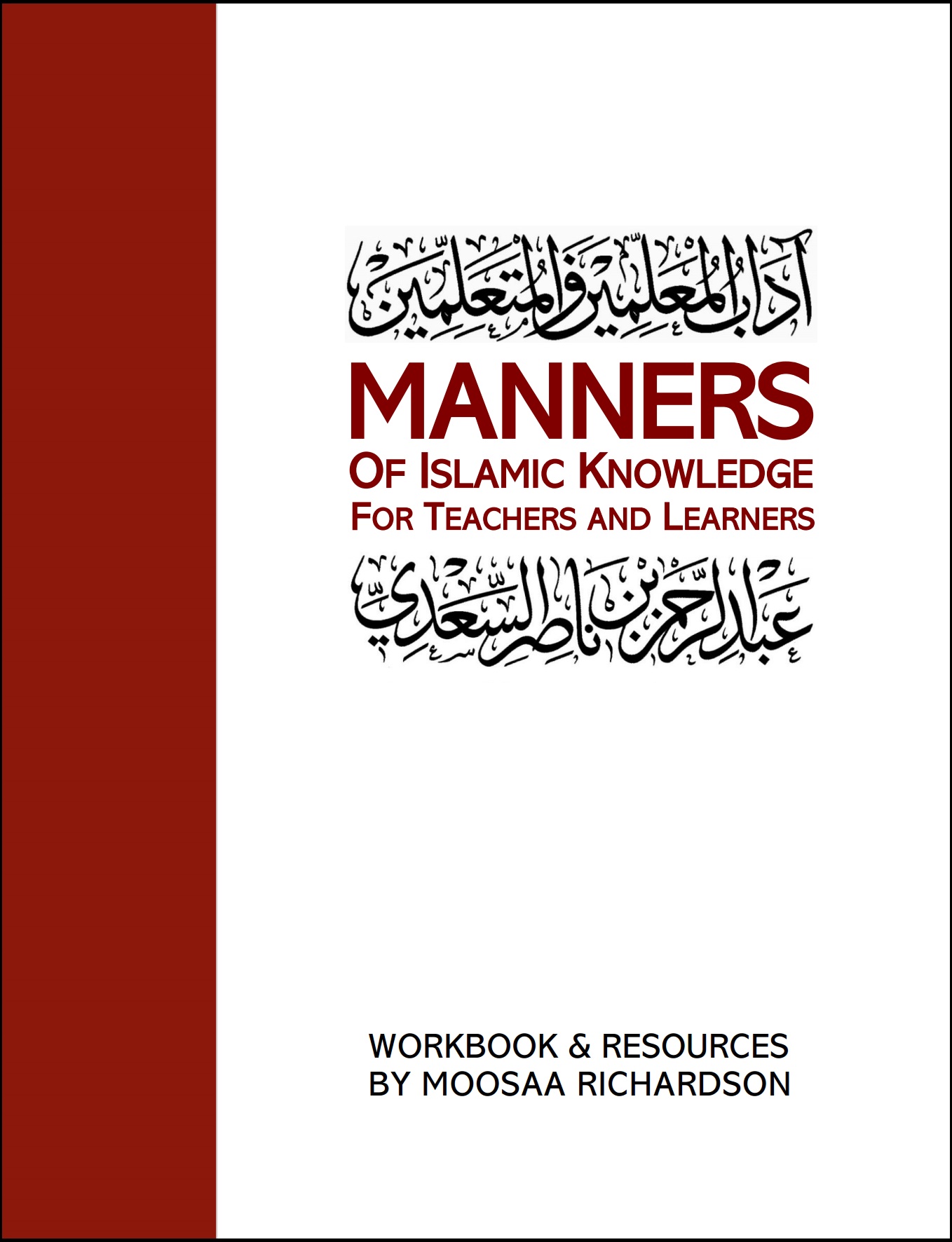
NEW PUBLICATION: Manners of Islamic Knowledge (Official Workbook)

Al-hamdu lillaah, we are pleased to announce that our latest publication is now available -by the Permission of Allah-, Manners of Islamic Knowledge for Teachers and Learners: Workbook & Resources for Your Study of al-Imaam as-Sa’dee’s Aadaab al-Mu’allimeen wal-Muta’allimeen

*This article features affiliate links, through which we may earn a small commission which helps maintain our website and da’wah activities, so we thank you, jazaakum Allahu khayran!

BRIEF OVERVIEW:

  • Summary: 21 major points of essential manners needed by teachers and students alike, from the insightful scholarly writings of al-Imaam ‘Abdur-Rahmaan ibn Naasir as-Sa’dee (may Allah have Mercy on him).
  • In this workbook, you have the entire Arabic text of the book, paired with a clear English translation, laid out with ample space for notetaking during classes. After the text there are other helpful resources, including the uninterrupted text, in its original Arabic (both voweled and unvoweled), as well as its uninterrupted English translation.
  • Available resources: MP3 recordings | Free PDF Version
  • Printed Workbook on Amazon (affiliate links):*
  • Mobile versions of the text only: ( ENGLISHعربي ) [for viewing on your phone specifically, large clear font, no space for note taking] coming soon, in shaa’ Allah
  • Sample pages:

Continue reading

Shaykh Fowzaan on Frauds Who Pretend to Have Islamic Knowledge

In the Name of Allaah, the Most Gracious, the Ever Merciful…

The great scholar, Shaykh Saalih al-Fowzaan (may Allaah preserve him), was asked:

What is “ta’aalum”? And what is your advice to the youth who face trials due to people engaged in ta’aalum?

He replied:

Ta’aalum is to feign knowledge. Feigning knowledge. It is when a person claims knowledge, while he is not knowledgeable in reality. He has not taken any knowledge directly from the scholars. Rather, he merely learned some things from books, solely from reading. He lacks sound fundamentals to build upon; he just reads things in books and proceeds according to his own understanding, likely erring more than being correct. This is a person of ta’aalum. He is a danger to himself (firstly) and to everyone (at large), since he Continue reading