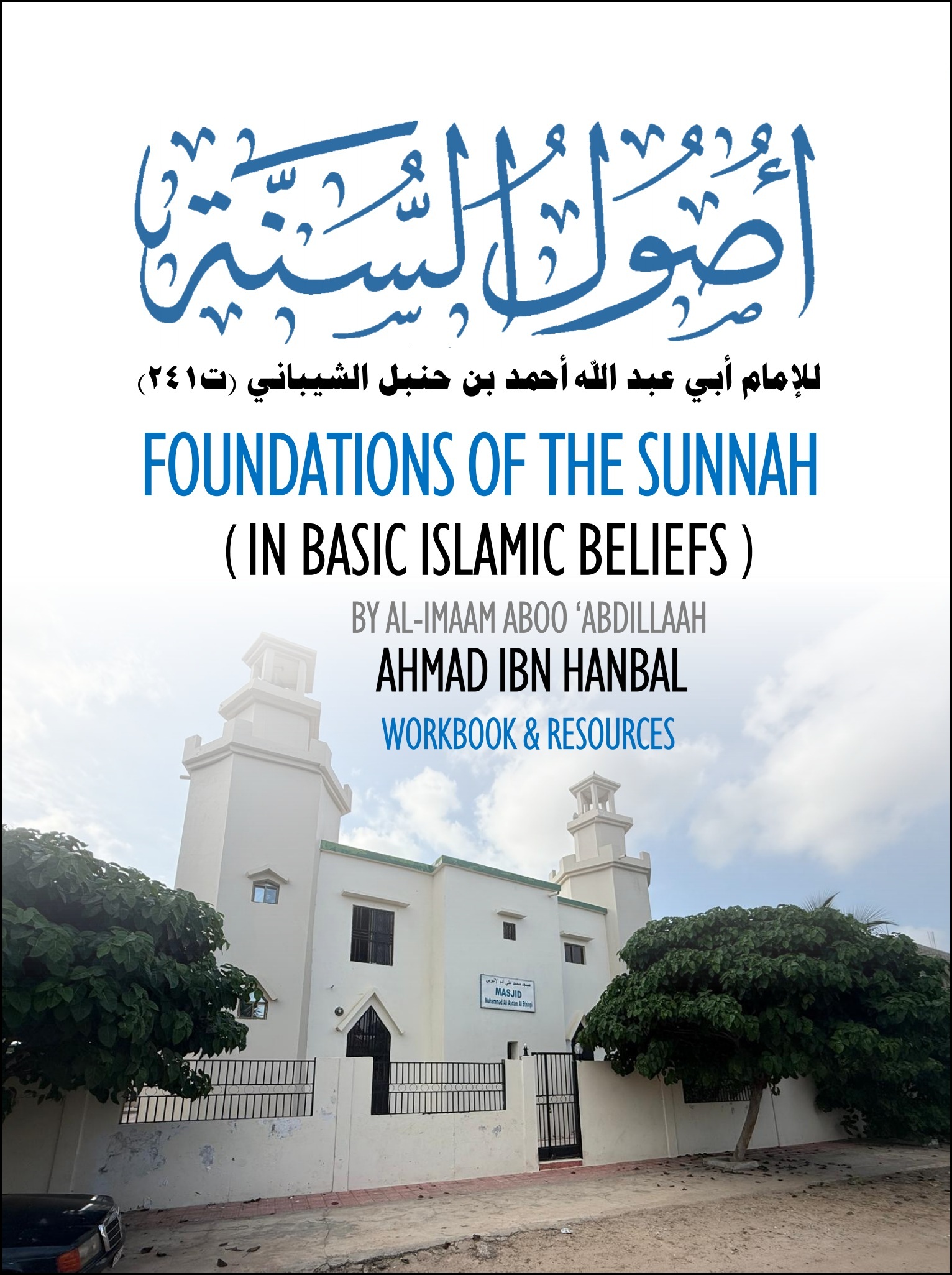
NEW PUBLICATION: Al-Imaam Ahmad’s Usool as-Sunnah (Foundations of Sunnah in Basic Islamic Creed) Workbook

Al-hamdu lillaah, we are pleased to announce that our latest publication is now available -by the Permission of Allah-, our workbook and resources for your study of Foundations of the Sunnah in Basic Islamic Beliefs, by the great imaam, Ahmad ibn Hanbal (may Allah have Mercy on him):

*This article features affiliate links, through which we may earn a small commission which helps maintain our website and da’wah activities, so we thank you, jazaakum Allahu khayran!

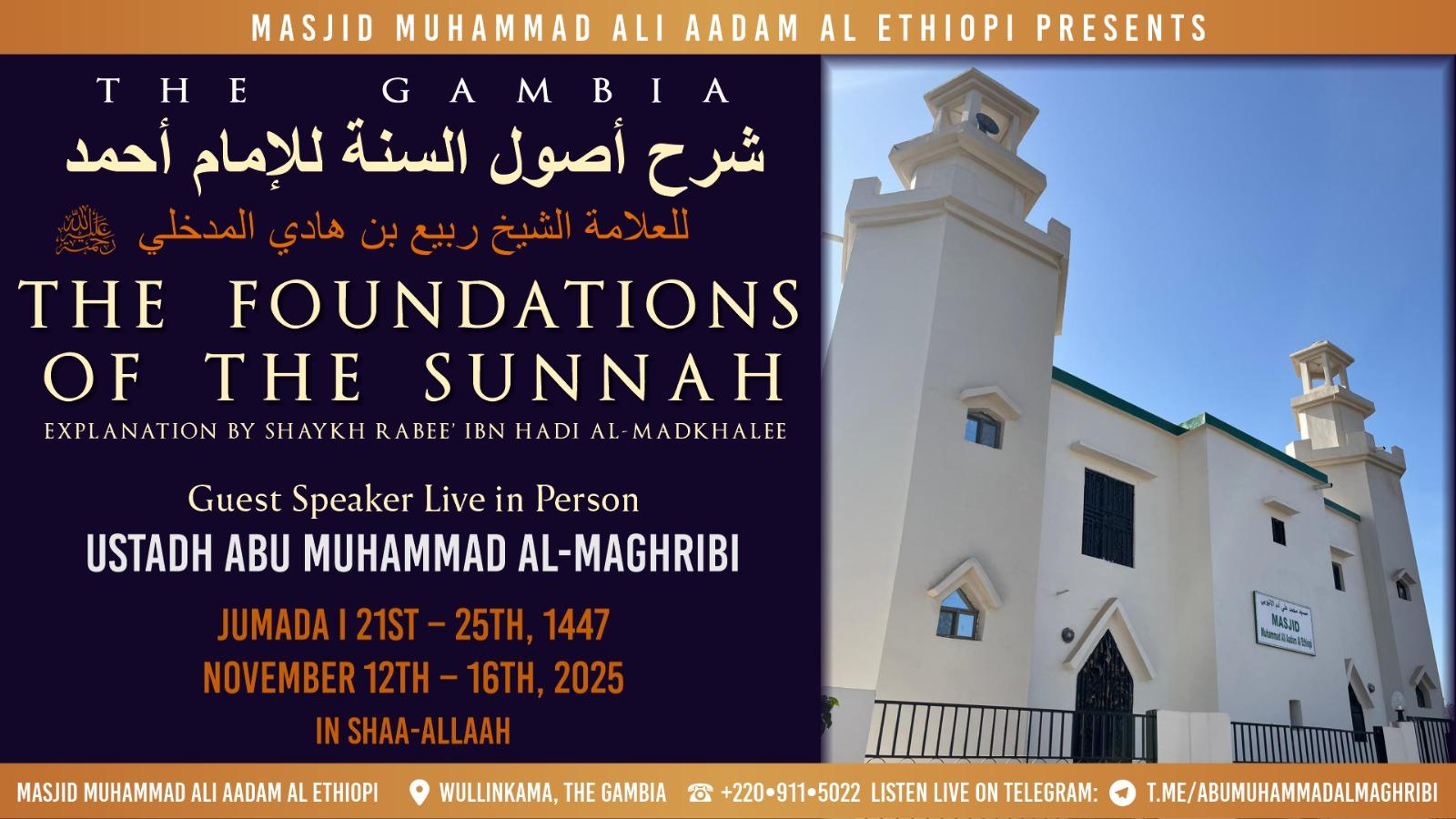
SPECIAL NEWS: This workbook will be used at the upcoming seminar in the Gambia, in shaa’ Allah:

BRIEF OVERVIEW:

  • Workbook and resources for the 35 major points of Muslim creed penned by the great imaam, Ahmad ibn Hanbal.
  • In this workbook, you have the entire Arabic text of the book, paired with a clear English translation, laid out with ample space for notetaking during classes. After the text there are other helpful resources, including the uninterrupted text, in its original Arabic (both voweled and unvoweled), as well as its uninterrupted English translation, and an original Arabic manuscript.
  • 82 pages, 8.5×11″ size, glossy cover, cream-colored pages (paperback) or white pages (hardcover)
  • Available resources: MP3 recordings (TBA) | Free PDF Version | Mobile version (English) | Mobile version (Arabic)
  • Printed Workbook on Amazon (affiliate links):*

Continue reading

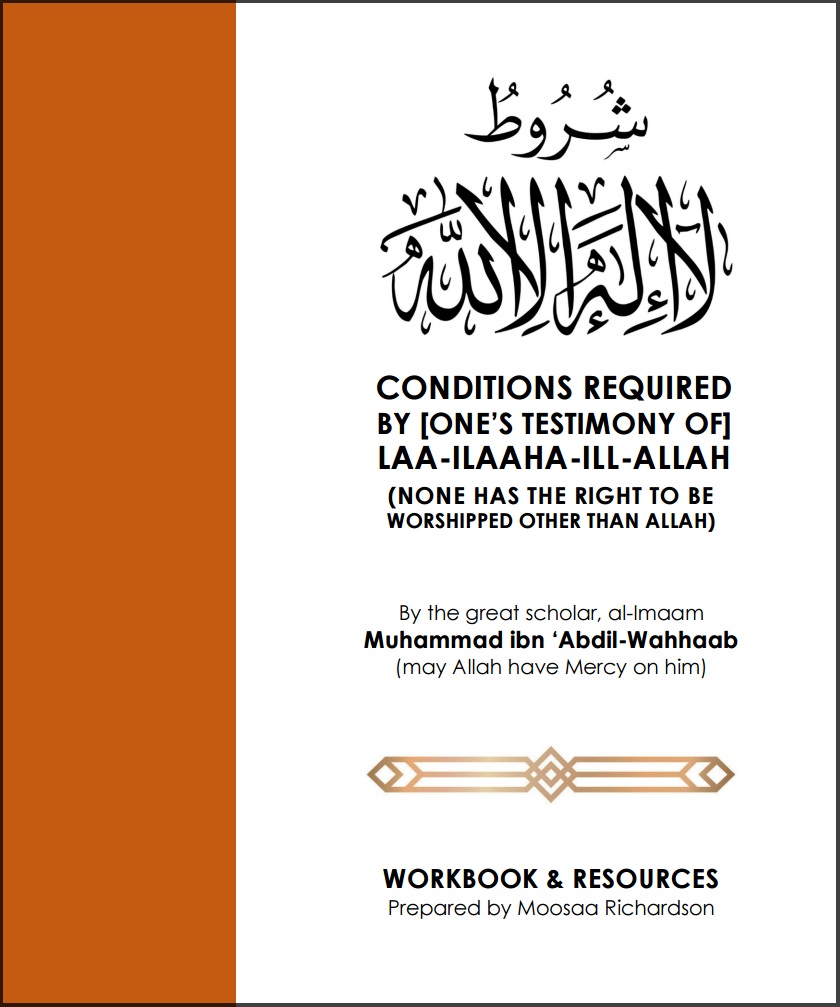
NEW PUBLICATION: Conditions Required by One’s Testimony of Laa-ilaaha-ill-Allah (Workbook)

We are pleased to announce that our latest publication is now available: Conditions Required by One’s Testimony of Laa-ilaaha-ill-Allah (Workbook)

*This article features affiliate links, through which we may earn a small commission which helps maintain our website and da’wah activities, so we thank you, jazaakum Allahu khayran!

BRIEF OVERVIEW:

  • Summary: In order to clarify the meanings and requirements of the Muslims’ testimony of faith, Shaykh al-Islam Muhammad ibn ‘Abdil-Wahhaab (may Allah have Mercy on him) penned a short explanation of the topic called, “Shuroot Laa-ilaaha-ill-Allah,” or: The Required Conditions of the Testimony of Faith. These conditions mentioned and explained by Shaykh al-Islam Muhammad ibn ‘Abdil-Wahhaab (may Allah have Mercy on him) can be summarized as follows: [1] Knowledge, [2] certainty, [3] sincerity, [4] honesty, [5] love, [6] compliance, and [7] acceptance.
  • In this valuable set of resources, you have the entire Arabic text of the book, paired with a clear English translation, laid out with ample space for notetaking during classes. After the text there are other helpful resources, including the uninterrupted text, in its original Arabic (both voweled and unvoweled), as well as its uninterrupted English translation. A chain of transmission is also included, as well as quizzes to check one’s basic understanding of the text. An answer key is provided on the bottom of page 3. The seven conditions are also presented in poetry form, from the book, Sullam al-Wusool, by Shaykh Haafith al-Hakamee (may Allah have Mercy on him).
  • Available resources: MP3 recordings | Workbook (digital version) [PDF]
  • Printed Workbook on Amazon (affiliate links):*

Continue reading

NEW PUBLICATION: Foundations of the Sunnah in Islamic Beliefs (Workbook and Resources)

In the Name of Allah, the Most Gracious, the Ever Merciful…

We are pleased to announce that our latest publication is now available: Foundations of the Sunnah in Islamic Beliefs: Workbook and Resources for Study of al-Imaam al-Humaydee’s Usool as-Sunnah

*This article features affiliate links, through which we may earn a small commission which helps maintain our website and da’wah activities, so we thank you, jazaakum Allahu khayran!

BRIEF OVERVIEW:

Continue reading

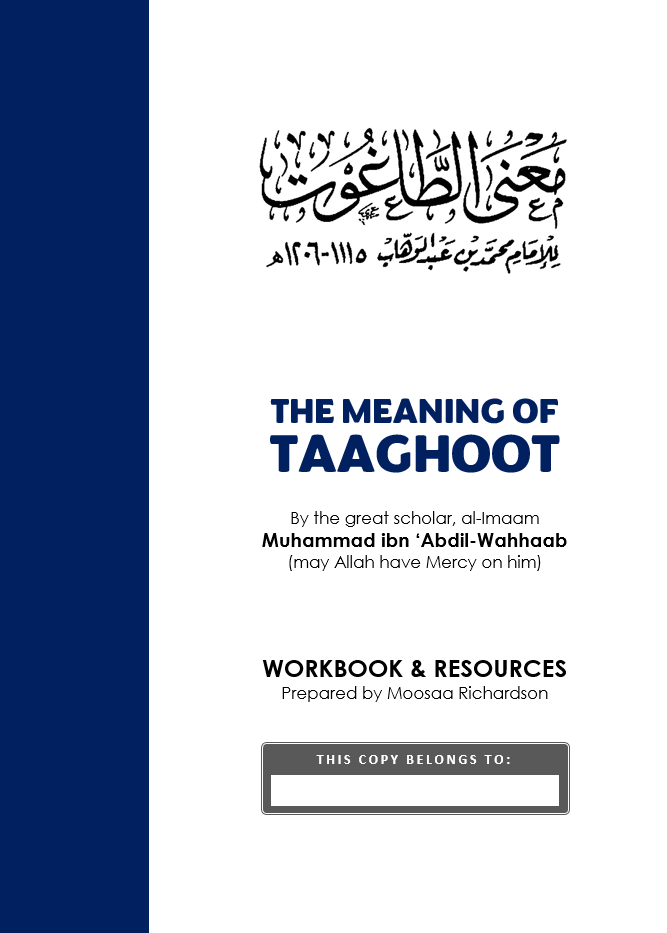
Resources: The Meaning of Taaghoot

In the Name of Allah, the Most Gracious, the Ever Merciful…

This page is a collection of helpful resources for those who are studying the text, Ma’naa at-Taaghoot (The Meaning of Taaghoot), by Shaykh al-Islam Muhammad ibn ‘Abdil-Wahhaab (may Allah have Mercy on him).

*This article features affiliate links, through which we may earn a small commission which helps maintain our website and da’wah activities, so we thank you, jazaakum Allahu khayran!

Get the paperback version of the workbook from Amazon (affiliate links):

HIGH-QUALITY MP3 AUDIO RECORDINGS (FREE): https://www.spreaker.com/podcast/things-that-nullify-someone-s-islam–1667061


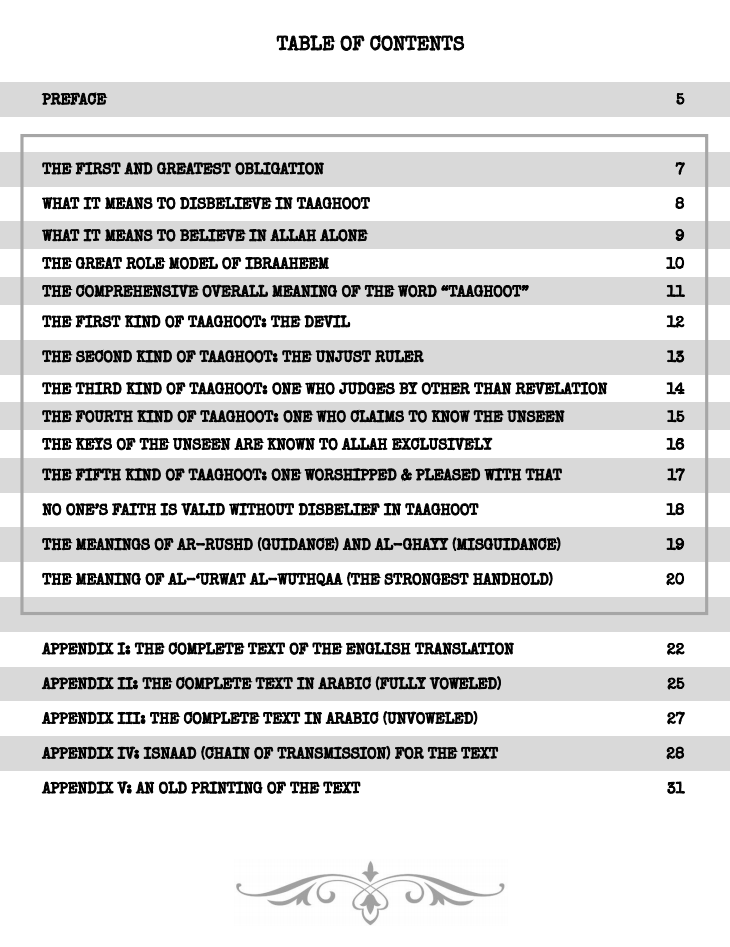
WORKBOOK: The Meaning of Taaghoot (31 pages)

  • Introduction by Moosaa Richardson
  • Full text in Arabic and English, with space for note taking
  • Uninterrupted Arabic text (both vowelled and unvowelled)
  • Isnaad (Chain of Transmission)
  • Older Arabic Printing of Text

Get the paperback version of the workbook from Amazon (affiliate links):

Get the PDF version of the workbook here: https://payhip.com/b/A3Pzu

Get the mobile version of the text (Arabic): https://payhip.com/b/wXIMj

Get the mobile version of the English translation: https://payhip.com/b/r7oC3

*This article features affiliate links, through which we may earn a small commission which helps maintain our website and da’wah activities, so we thank you, jazaakum Allahu khayran!

The Importance of ‘Aqeedah (Creed), by Shaykh Ibn Baaz

In the Name of Allah, the Most Gracious, the Ever Merciful…

The great scholar, Shaykh ‘Abdul-‘Azeez ibn Baaz (may Allah have Mercy on him), was asked the following question:

QUESTION: Teachers focus so much on matters of ‘aqeedah (creed) in their call. It is well known that it is of great importance, and it has a great status, since establishing a foundation of creed is the great focus of Islam, however we hope you could re-direct our focus on social manners and repelling lowly manners when building the creed. And why is it that most often scholars neglect this so much?

ANSWER: In each case, it is well known about the scholars that they focus on this and that. ‘Aqeedah -as you have mentioned, O questioner- is the central focus. It is the foundation. Yet with this, most of the people of knowledge in the various lands do not focus on ‘aqeedah, despite what you have said. They speak about manners and other things, about prayer, zakaat, prayer timings, and other things. ‘Aqeedah is neglected, so much so that graves are being worshipped in their midst, things beside Allah! Shirk (polytheism) has even taken place among them, yet they do not even sense it!

The scholar himself may even fall into associating partners with Allah, as he lived upon shirk with his father, with his uncle, and with his teacher. They lived their lives committing shirk due to some reasons: They did not speak about ‘aqeedah. They did not have any focus on ‘aqeedah.

You find him teaching, yet worshipping other than Allah. You find him in the masjid teaching, but then he supplicates to al-Badawee, or he supplicates to al-Husayn, or ‘Abdul-Qaadir, because he has lived his life like this, he and his father, and his grandfather, and his peers. This is from the results of neglecting ‘aqeedah and not focusing on ‘aqeedah.

You find him to be an insightful expert on the rulings of divorce, endowments, rental (or work) contracts, zakaat, bequeathals, and other things, because he studied them and focused on them. As for ‘aqeedah, then he does not focus on it, nor does he know it.
Even when he is good [not committing shirk], he still focuses on the ‘aqeedah of the people of rhetoric, along with what such people delve into of rhetoric, and the beliefs which are taught by the people of rhetoric among the Ash’ariyyah, Jahmiyyah, and Mu’tazilah [cults]. He is heedless about the Salafee ‘aqeedah, held by the companions of the Messenger (may Allah raise his rank and grant him peace), what was held by our righteous predecessors of affirming the Names and Attributes [of Allah], issues of belief in Allah, the towheed of worship, and not associating partners with Allah, the Mighty and Majestic, and focusing on these matters.

Thus, it is extremely important as an emphasized duty that one must focus on ‘aqeedah. Let the scholars focus on it when they clarify matters to both the common people and the elite. Let the lessons be primarily focused on it, while they still give focus to manners and other rulings. Neither this nor that should be neglected, yet let the greater focus be on ‘aqeedah.

Shaykh Muhammad [ibn Ibraaheem] (may Allah have Mercy on him) used to say in his writings to some his opponents who would write to him, debating issues of ‘aqeedah: “I want you to study ‘aqeedah like how you study the Chapter of Endowments.” Meaning: As you study and give great focus to issues of endowments between the people, I hope you would study ‘aqeedah, the chapter about rulings on the apostate, with the same attention you give to the chapter on endowments.

If they were to study the chapter on rulings on apostates in the books of Fiqh written by the scholars of each math-hab, if they would only study the chapter about apostates and focus on it, the falsehood and polytheism they have fallen into would become clear to them. Yet, they are heedless about that chapter, as they do not encounter any questions about it, nor is there any focus on it. Instead, you find them busy with issues of endowments and their caretakers: How should the endowment be executed? How should extra profit from an endowment be dealt with? How about rent, how should it be rented? How should people interact with the orphan’s estate?

They are occupied with these [things], yet they have neglected ‘aqeedah, since they have no focus on it, and since the common people do not ask about it. Thus, it dried up, and they lost focus on it. People then began to fall into obvious acts of associating partners with Allah, worshipping graves and righteous people. Due to this neglect, you find al-Badawee and others, So-and-So and So-and-So, in Egypt, the Levant, Iraq, and every place, are worshipped along with Allah, while the scholars are dressed in turbans, calling to that, doing that along with the common people.

They’ve caused confusion about this matter, and neglected it, as they did not give it any attention, so much so that the common people have fallen into shirk because of them. They now remain at gravesites in dedication, calling upon them along with Allah, seeking relief from them, asking them to fulfill their needs, heal them, and grant them victory over their enemies. These kinds of things are happening among the people. Anyone who would deny this who travels to other lands, go by the grave of al-Badawee, al-Husayn, So-and-So, and So-and-So. You find the people remaining there in devotion. One says: “O my master, Fulaan, Help! Heal my sick [family]! Give me victory over my enemy! Do this or that for me!” So much so, they have even gone so far as to ask them for children, for their wives to get pregnant, or to give them this or that! We ask Allah for well-being! They have disregarded Allah, so He disregarded them; there is no power nor any ability except by way of Allah.

SOURCE: The shaykh’s official website | Arabic Audio (MP3) | Transcript (Arabic & English) 

Translated by: Moosaa Richardson (1446.03.03)

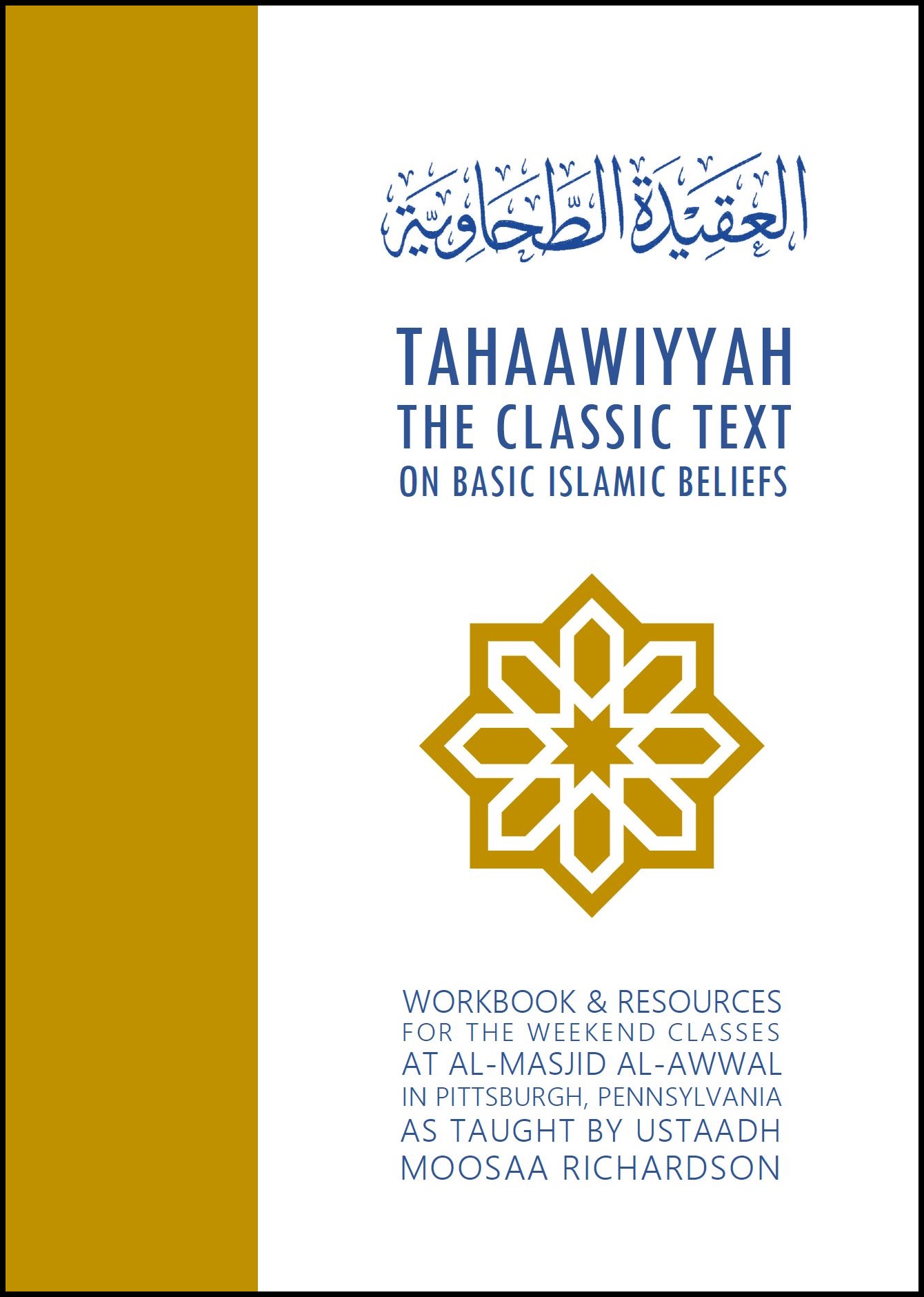
RESOURCES for the New Course: al-‘Aqeedah at-Tahaawiyyah

In the Name of Allah, the Most Gracious, the Ever Merciful…

QUICK LINKS TO THE NEW WORKBOOK:
Amazon USA: Paperback | Hardcover | Kindle
Amazon UK: Paperback | Hardcover | Kindle
Amazon CAN: Paperback | Hardcover | Kindle
Amazon AUS: Paperback | Hardcover | Kindle
PDF Versions:  PDF Workbook | English Text (Mobile) | Arabic Text (Mobile)
Wholesale orders: Email: Publications@Bakkah.net [Catalog: USA | UK]

When we recommend any products available on Amazon, as an Amazon Associate we may benefit from qualifying purchases when you follow our links from Bakkah.net. This helps us offset the costs of maintaining the website, and we do appreciate your understanding and support!

Here you will find helpful resources and guidance, by Allah’s Permission, connected to the study of al-‘Aqeedah at-Tahaawiyyah, the classic primer on basic Islamic creed in the English Language and information about the newly available workbook.

The Course: al-‘Aqeedah at-Tahaawiyyah

We’ve completed a few introductory lessons in preparation for our study of the text of al-‘Aqeedah at-Tahaawiyyah. So far, Continue reading