
In the Name of Allah, the Most Gracious, the Ever Merciful…
We are pleased to announce that our latest publication is now available: Foundations of the Sunnah in Islamic Beliefs: Workbook and Resources for Study of al-Imaam al-Humaydee’s Usool as-Sunnah

*This article features affiliate links, through which we may earn a small commission which helps maintain our website and da’wah activities, so we thank you, jazaakum Allahu khayran!
BRIEF OVERVIEW:
- Summary: Al-Imaam ‘Abdullah ibn az-Zubayr al-Humaydee (d.219) penned this short treatise on the timeless creed of the Muslims entitled Usool as-Sunnah, emphasizing some key points of correct belief and refuting the errors of those who have misrepresented them. The workbook includes multiple choice quizzes, an isnaad (chain of transmission), an original manuscript, and other helpful resources.
- Available resources: MP3 recordings | Workbook (digital version) [PDF] | Mobile Version (English) | Mobile Version (Arabic)
- Printed Workbook on Amazon (affiliate links):*
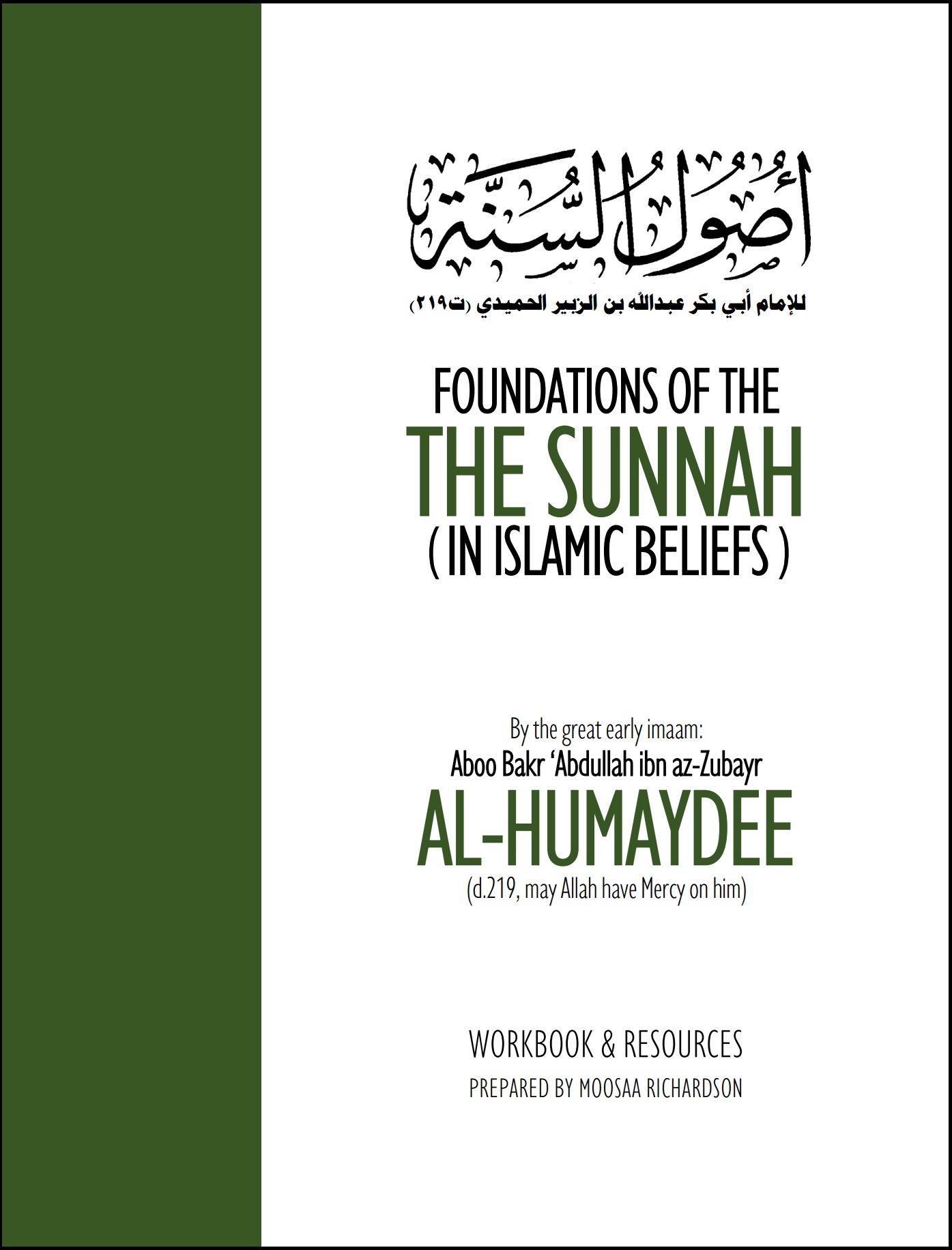
A great man of dutiful advice and sincere concern for the Muslims, al-Imaam ‘Abdullah ibn az-Zubayr al-Humaydee (d.219), an imaam (highest ranking scholar) according to the imaams of the religion, penned this short treatise on the timeless creed of the Muslims entitled Usool as-Sunnah, one which emphasizes some key points of correct belief and refutes the errors of those who have misrepresented them.
- He begins by stressing the importance of affirming Allah’s divine pre-decree (Qadar) and explaining how that affects each person as he navigates the trials of prosperity and adversity in this life. This refutes the deviation of the Qadariyyah cult.
- He then explains the nature of eemaan (faith), that it includes speech and action, and that it fluctuates. This is a refutation of the Murji’ah cult.
- He then refutes the misguidance of the Shee’ah and Naasibiyyah cults, as he emphasizes the inviolable status of the noble companions, the upright carriers of Islam and its first wave of teachers and callers, may Allah be pleased with all of them.
- After that, he declares that the Quran is the uncreated speech of Allah, and that Allah will indeed be seen in the Hereafter, as opposed to the Jahmiiyyah and Mu’tazilah cults who claimed otherwise.
- Special attention is then given to the topic of Allah’s Attributes, setting the record straight regarding deviant foreign philosophies which had been imported into the ranks of the Muslims.
- He concludes with detailed elaboration on the issue of takfeer, the impermissibility of considering sinners to be outside of Islam because of their disobedience. This is a refutation of the Khawaarij cult.
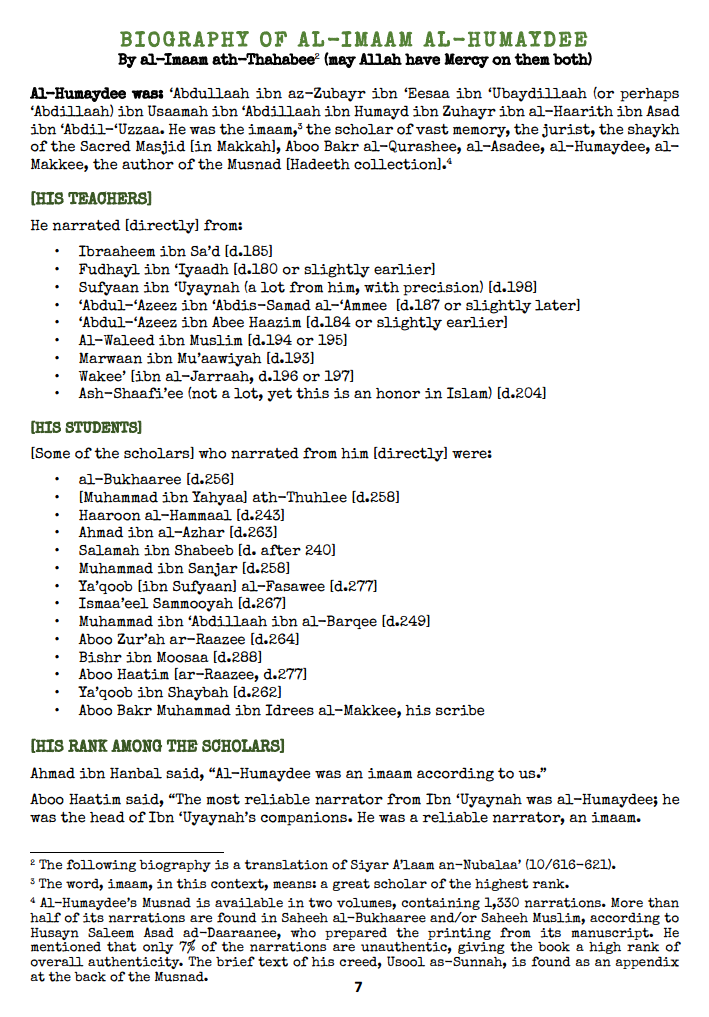
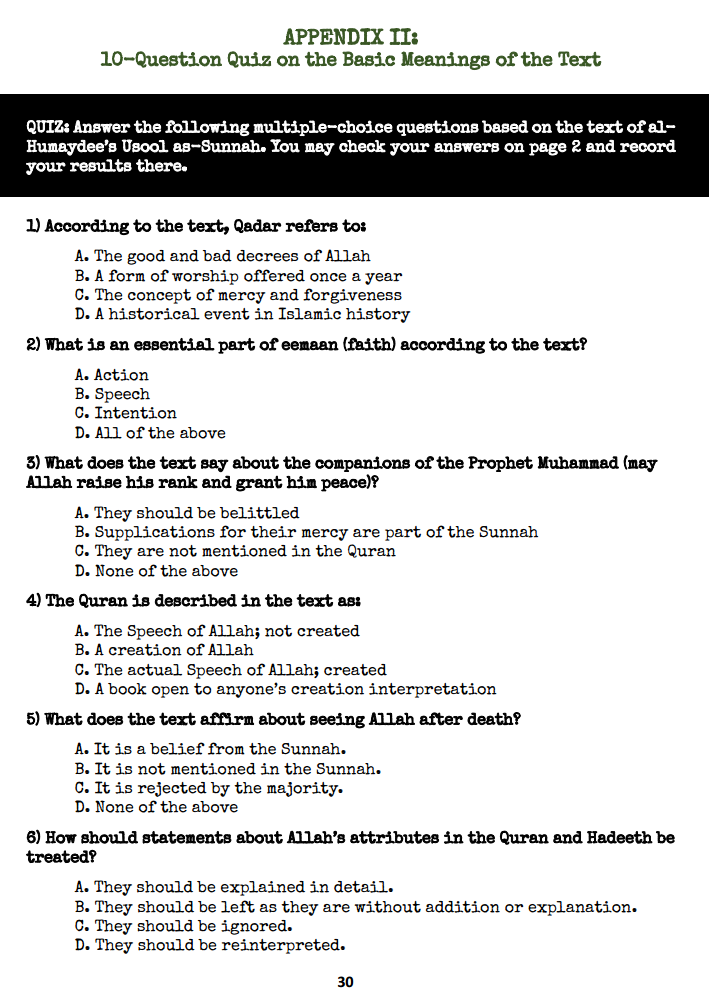
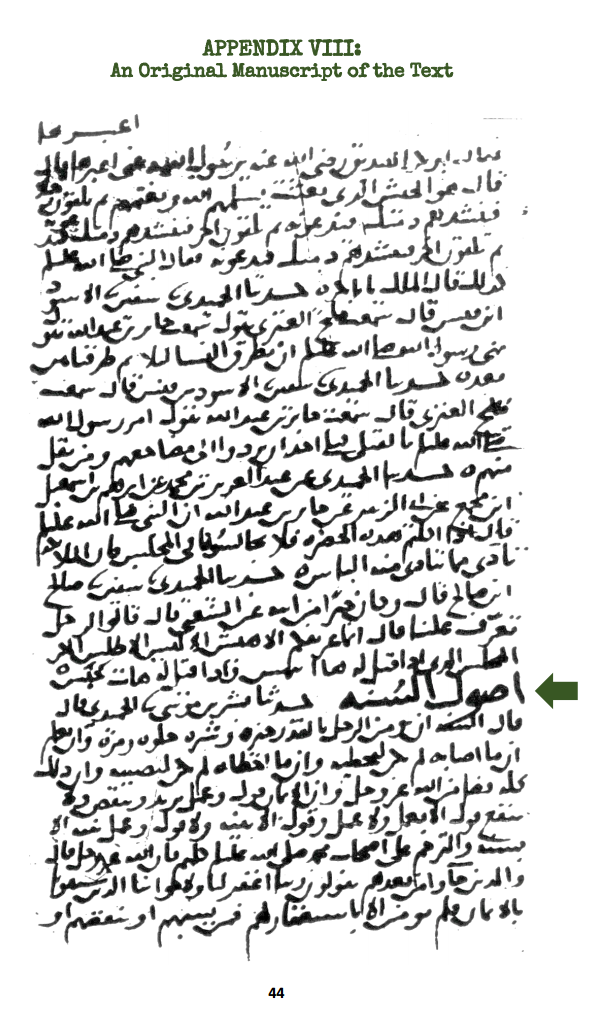
To aid my brothers and sisters in studying and understanding this important text, I have prepared this workbook, asking Allah to make it something of benefit for His sincere worshippers.
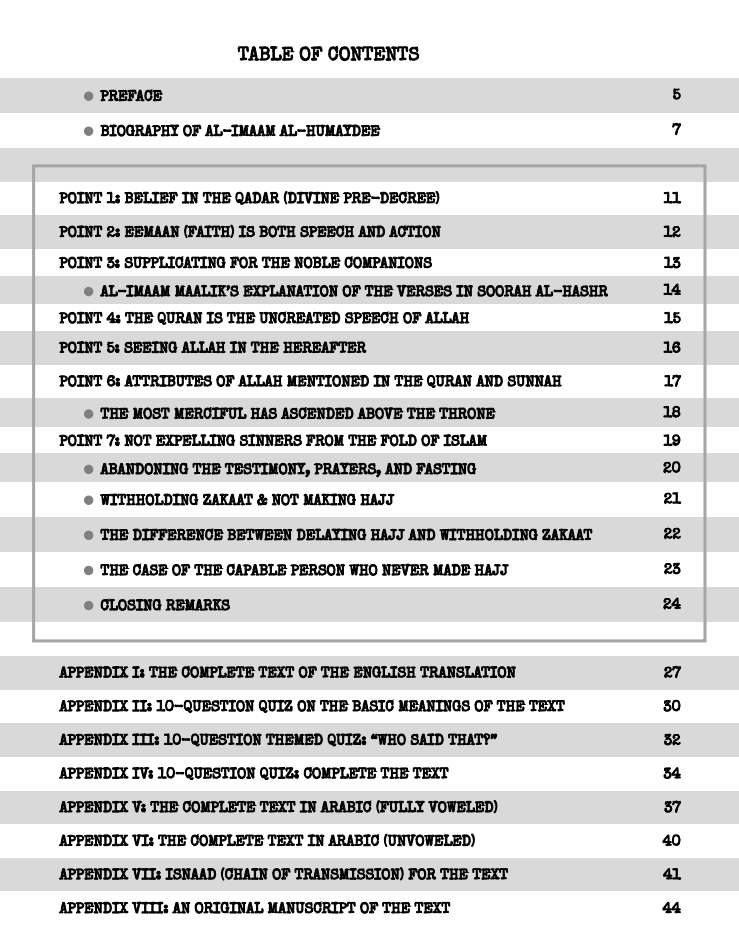
You will find the text of the book, paired with an English translation, laid out over the forthcoming pages, with ample space for notetaking during class. Before the text is a biography of the author. After the text are helpful resources, including the uninterrupted text, in its original Arabic (both voweled and unvoweled), as well as its uninterrupted English translation. A chain of transmission is also included, as well as an original Arabic manuscript as well. Three multiple choice quizzes and their answer keys are available (p.2) to help you assess your level of understanding of the text.
Additionally, you can find some helpful resources in the English language, like the recorded lessons of our brother, Shaykh ‘Abdulilah Lahmami (may Allah bless and preserve him), a four-part series in explanation of this text, which is available as a playlist on the “Markaz Muaadh” Soundcloud channel at the following link:
https://soundcloud.com/markazmuaadh/sets/usool-us-sunnah-of-imaam
Additionally, our brother, Shaykh Uways at-Taweel (may Allah bless and preserve him) has done a five-part explanation of this text, available as a playlist on the “Masjid Bin Baz Radio” channel on Soundcloud, at the following address:
https://soundcloud.com/masjidbinbazradio/sets/explanation-of-im-m-abi-bakr
Also, our brother, Shaykh Taqweem Aslam (may Allah bless and preserve him), has explained this text in 22 sessions, as found as a playlist on the “Tawheed Rochdale” Soundcloud account, at the following address:
https://soundcloud.com/tawheedrochdale/sets/usool-us-sunnah-of-al-imaam-al
After seeing how much attention the noble teachers in the U.K. gave to this text, I was delighted to learn that Shaykh Hamzah ‘Abdur-Razzaaq of Masjid Ibn Baaz in South Philadelphia (may Allah bless and preserve him and his community) has planned a weekend seminar this summer, one focused on the study of al-Imaam al-Humaydee’s Usool as-Sunnah, in shaa’ Allah. We ask Allah to grant success to him and all of the organizers, speakers, and attendees.
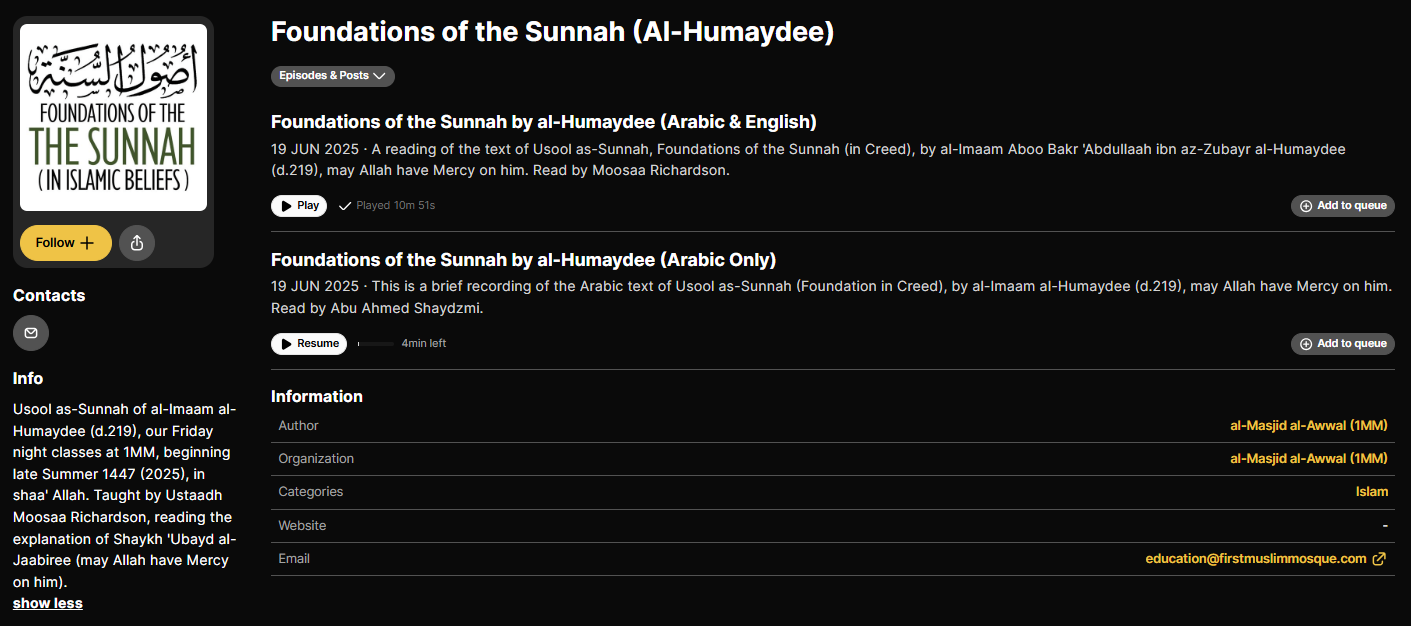
Furthermore, we also plan to study al-Humaydee’s Usool as-Sunnah in our upcoming Friday night classes at the First Muslim Mosque (Al-Masjid al-Awwal) in Pittsburgh, Pennsylvania, in shaa’ Allah. Some initial audio resources are already available at the masjid’s Spreaker channel, at the following link:
https://www.spreaker.com/podcast/foundations-of-the-sunnah-al-humaydee–6661024
Available resources: MP3 recordings | Workbook (digital version) [PDF]
- Printed Workbook on Amazon (affiliate links):*
*When you use our affiliate links, we may earn a small commission which helps maintain our website and da’wah activities, so we thank you, jazaakum Allahu khayran!
السلام عليكم ورحمة الله وبركاته
Inshā’Allāh this message reaches you.
Are late fees only pertaining to “loans”?
If i am paying for a service which is due to be paid on a set day every month and I miss that payment inducing a late admin fee, does this still fall under ribā?
وعليكم السلام ورحمة الله وبركاته
If they loaned you their labor or service, to be paid for later, as a debt on you, and there is a clause which allows them to increase the amount when you do not pay on it on time, this is an impermissible agreement involving clear ribaa, whether it called late fees, or penalties, or service charges. And Allah knows best.
السلام عليكم ورحمة الله وبركاته
I live in Iran and the meat is shia-slaughtered.
Regarding gelatin in pills you mentioned Ustadth how I should take it as it’s haram unless proven halal.
I have an acid reflux disease which can cause further problems and issues in my body in the future and the doctor has prescribed certain pills for me.
Is it allowed to take them?
بارك الله فيكم
وعليكم السلام ورحمة الله وبركاته
In our pharmacies in the West, they make the pills for you, so you commonly have options to choose from: tablet form, gelcap (usually pork/gelatin, so avoid it), vegan gelcap, etc. Talk to your pharmacist; maybe these options are available. May Allah bless you and give you success.
As salamu alaykum Ustadh
What kind of food is a husband obliged to provide his family with?
If he withholds from buying them a particular type of food such as meat for a whole week, to punish them or ‘to make them more grateful’ is that permissible? The initial problem was never about meat. Meat can be afforded alhamdulillah and Everyone around us buys and consumes meat alhamdulillah.
Wa ‘alaykum as-Salaamu wa rahmatullaah. Allah’s command to spend on those under our care (like what is found in Quran 4:34) was left general, without being specified as a certain amount or of a particular type of food. This means that the matter is understood in light of the customs of your time and place. When the people of your time and place eat cooked rice and meat, this is what is required to provide, based on one’s ability as well. A rich man provides more expensive types of foods based on his culture. A poor man provides less expensive types of foods based on his culture. Our shaykh, Ibn ‘Uthaymeen (may Allah have Mercy on him) expressed this principle in his poetry in Usool al-Fiqh saying:
وكل ما أتى ولم يحدد ## بالشرغ كالحرز فبالعرف احدد
Review Line 65 of the poetry, as found here: https://www.bakkah.net/en/new-publication-islamic-legal-maxims-poetry-of-shaykh-uthaymeen-workbook.htm
So to answer this question, if that meat which he withholds as a punishment is basic and considered a staple food in their culture, then it is not his right to prevent them from it, as a punishment. This would be adding sin on top of sin, not rectifying anything. If it were something deemed extra and not a staple food, like ice cream for example, then he could withhold this from them as a punishment, or provide it as encouragement or rewards for certain goals, etc., but not meat when that kind of meat is considered a staple food. With a more detailed look at the topic, it might also be noted that certain types of meat might be considered extra/non-staple, like ribeye steaks maybe. He might say: “I was going to buy ribeye steaks for you this week as a treat, but because of such-and-such behavior, I have decided to buy regular ground beef instead.” And Allah knows best.