
In the Name of Allah, the Most Gracious, the Ever Merciful…
This page is a collection of helpful resources for those who are studying the text, Ma’naa at-Taaghoot (The Meaning of Taaghoot), by Shaykh al-Islam Muhammad ibn ‘Abdil-Wahhaab (may Allah have Mercy on him).
*This article features affiliate links, through which we may earn a small commission which helps maintain our website and da’wah activities, so we thank you, jazaakum Allahu khayran!
Get the paperback version of the workbook from Amazon (affiliate links):
HIGH-QUALITY MP3 AUDIO RECORDINGS (FREE): https://www.spreaker.com/podcast/things-that-nullify-someone-s-islam–1667061
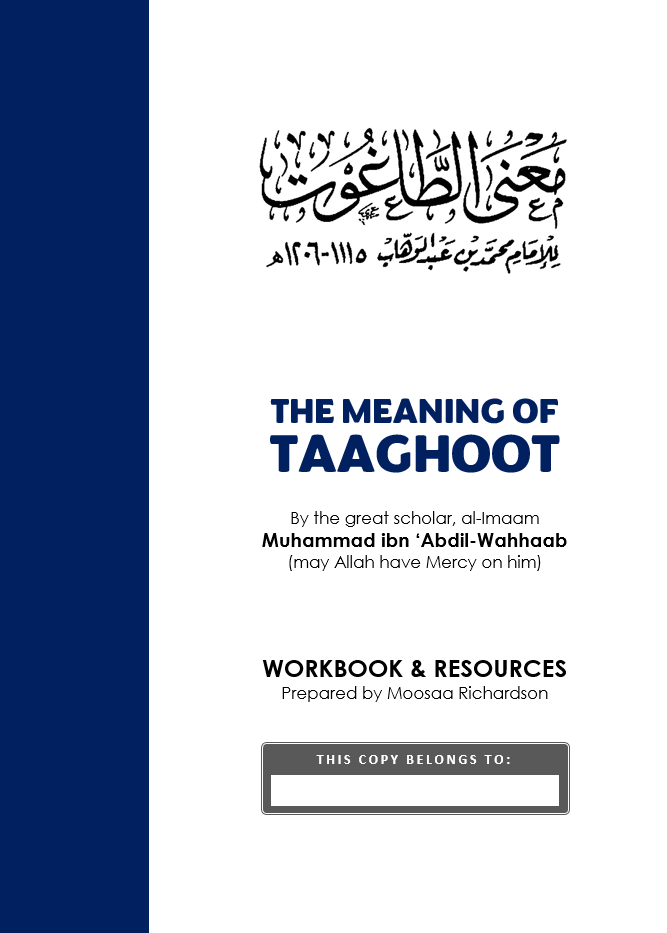
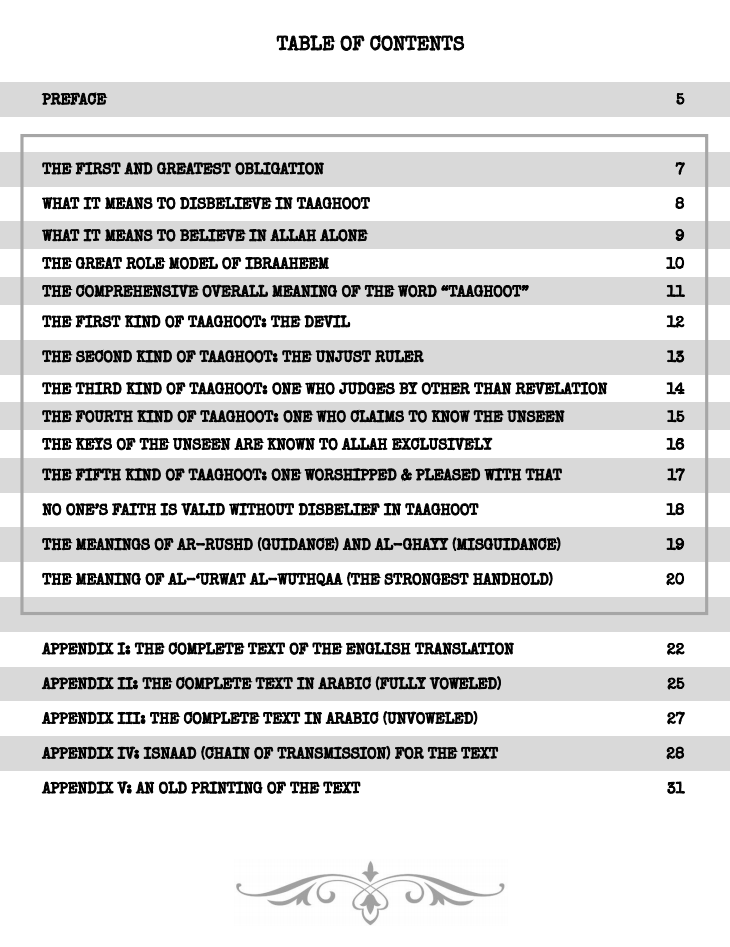
WORKBOOK: The Meaning of Taaghoot (31 pages)
- Introduction by Moosaa Richardson
- Full text in Arabic and English, with space for note taking
- Uninterrupted Arabic text (both vowelled and unvowelled)
- Isnaad (Chain of Transmission)
- Older Arabic Printing of Text
Get the paperback version of the workbook from Amazon (affiliate links):
Get the PDF version of the workbook here: https://payhip.com/b/A3Pzu
Get the mobile version of the text (Arabic): https://payhip.com/b/wXIMj
Get the mobile version of the English translation: https://payhip.com/b/r7oC3
*This article features affiliate links, through which we may earn a small commission which helps maintain our website and da’wah activities, so we thank you, jazaakum Allahu khayran!
Salam o Alaikum Ustadh
Where can I find the complete reading of this book in English for this workbook?
“The Meaning of Taaghoot”
Kindly direct as I cannot locate it.
Jazak Allah u Khayran
Wa ‘alaykum as-Salaamu wa rahmatullaah. It is found among the audio resources provided above: “HIGH-QUALITY MP3 AUDIO RECORDINGS (FREE): https://www.spreaker.com/podcast/things-that-nullify-someone-s-islam–1667061“
As-salāmu ʿalaykum wa raḥmatullāh. Shaykh, I’m asking the following on behalf of a brother:
Shaykh, I live in Iran and have come across different scholarly opinions regarding gelatin. Some say it is ḥarām, while others say it is ḥalāl. The gelatin here is usually produced from animals slaughtered by Shīʿah, and both views have good dalāʾil. I am unable to weight between them. What should I do in this case?
I heard, Some scholars say follow the easiest opinion, some say follow the majority, others, you can chose between one, and lastly, that you have to follow the safest opinion.
Jazākumu Allāhu khairā
Wa ‘alaykum as-Salaamu wa rahmatullaah wa barakaatuh. Act by this basic maxim: What you know to be haraam remains haraam, until you have absolute clarity to say otherwise. So if it is 100% clear to you that istihaalah has taken place, meaning: the basic nature of the substance of pork or carrion has changed, like how feces goes into the ground as fertilizer and becomes part of the halaal food that grows there, or like how grape juice (halaal) has changed into wine (haraam), if you are not 100% clear that this change has certainly occurred, then consider it to remain as it was, a by-product of pork or whatever animal or thing, and it keeps that ruling. This is not only principle-based, but it is the safest way to approach this issue. This is what I hold for myself, and this is what I advise others with. Consider gelatin to have the ruling of being a by-product of whatever it is taken from, so gelatin from pork (which is the default source of ambigious gelatin) is haraam (as judged by the scholars of the Lajnah), and gelatin from fish is halaal. And Allah knows best.
Jazākumu Allāhu khairan, the brother from Iran asks:
I don’t know whether the gelatin has gone through Istiḥālah because I am not aware of what the people who made the product have done.
Isn’t it that for gelatin to be gelatin the transformation has to happen 100%?
That is the exact issue, is the process of refining the pork into gelatin one of istihaalah or not? I am not sure. If you are not sure, then consider it to keep its original ruling, until clarity comes to you that it is something else with a different ruling. And Allah knows best.
Assalamualaikum. I wanted to make a bank account in one of the islamic banks in my country however I noticed that they use the image of a greek temple in their app or on their website. Can I still make an account and use the app or should I not do it? Does the ruling change if I can’t find any alternative which doesn’t have it? Also one of these islamic banking branches is called mustaqeem, could I make an account in this branch or not? Is calling it mustaqeem disrespectful considering often times banks do engage in riba.
Wa ‘alaykum as-Salaamu wa rahmatullaah wa barakaatuh. Use the bank which is the least harmful and least involved in ribaa when you need a bank account. Whether or not the bank is Muslim-owned or claims to be halaal or ribaa-free is irrelevant. So many banks claim to be ribaa-free, but they are not. Here in America, some banks offer a basic checking account, where you can keep any balance, and there in no ribaa for or against you, and there is no credit line, so no late fees on overdraft coverage credit or similar forms of hidden ribaa.