About admin

Admin of www.Bakkah.net/en

Ibn ‘Umar’s Devout Following of the Sunnah [Shaykh Muhammad ibn Aadam]

In the Name of Allaah, the Most Gracious, the Ever-Merciful…

‘Abdullaah ibn ‘Umar, the son of the second Caliph, ‘Umar ibn al-Khattaab (may Allaah be pleased with them both), was known for his devout following of everything the Messenger of Allaah (may Allaah raise his rank and grant him peace) did. Imaam Ibn Maajah reports that “Whenever he heard a hadeeth from the Messenger of Allaah (may Allaah raise his rank and grant him peace), he would not do anything more than it, nor would he stop until fulfilling it (completely).” [1]

Shaykh Muhammad ibn ‘Alee ibn Aadam (may Allaah preserve him) [2] said:

From the benefits (of this report) is knowing how devout Ibn ‘Umar (may Allaah be pleased with him and his father) was in his following of the Prophet (may Allaah raise his rank and grant him peace). He (may Allaah be pleased with him) was well known for that.

‘Abdullaah ibn Wahb narrated from Maalik, from someone [3] who told him Continue reading

Is Defending and Honoring the Scholars a Call to Blind Following?

In the Name of Allaah, the Most Gracious, the Ever-Merciful…

A visitor recently asked about the translation of Shaykh Saalih as-Suhaymee’s advice to support and defend the honor of the scholars of Islaam (found here), saying:

Since these guys are contemporary men who are human and prone to error and sin like all of us, why would we defend them? Isn’t this a call to blind following? [abridged]

To be clear: We have certainly not promoted the blind following of these scholars, nor have we claimed they are perfect without flaws. Nor are we ever to defend any of them in falsehood.

However, dear questioner, may Allaah give you better than the corrupt manhaj (methodology) of Yasir Qadhi, Almaghrib Institute, and those upon their way, your ideas clearly seem to reflect the opinions they commonly lead people into – a total loss of any meaningful distinction between us and the scholars of Islaam, as it relates to the virtues of the scholars, their special status amongst us, and our need to refer to them to learn our Religion. The goal is to disconnect the people from their scholars, which facilitates the spread of deviation very easily.

May Allaah give you better – If Allaah has commanded us in His Quran (more than once) to ask the people of knowledge when we do not know [16:43, 21:7], don’t we need to know who they are?!

Dear questioner, may Allaah give you better! – Know that Allaah has established a very high status for the scholars of Islaam in his Glorious Book, saying: Continue reading

Sunan Ibn Maajah: Chapter One – Following the Sunnah

In the Name of Allaah, the Most Gracious, the Ever Merciful…

The following is an excerpt from an English translation of the Introduction to Sunan Ibn Maajah. It is the very first chapter which includes eleven important authentic hadeeths on the topic of:

Following the Sunnah of the Messenger of Allaah, may Allaah raise his rank and grant him peace

1) Narrated by Aboo Hurayrah: The Messenger of Allaah (may Allaah raise his rank and grant him peace) said (what means), “Whatever I have commanded you, do it. Whatever I have forbidden you, refrain from it.”

2) Narrated by Aboo Hurayrah: “The Messenger of Allaah (may Allaah raise his rank and grant him peace) said (what means): “Leave me as I have left you (Don’t ask me the minor things that I have avoided to tell you). For those who came before you were doomed because of their questions and differences with their Prophets. If I command you to do something, then do as much of it as you can, and if I forbid you from doing something, then refrain from it.’”

3) Narrated by Aboo Hurayrah: “The Messenger of Allaah (may Allaah raise his rank and grant him peace) said (what means): ‘Whoever obeys me, obeys Allaah; and whoever disobeys me, disobeys Allaah.’”

4) Narrated by Aboo Ja’far: “Whenever Ibn ‘Umar heard a hadeeth from the Messenger of Allaah (may Allaah raise his rank and grant him peace), he would not do more than it said, and he would not do less.”

5) Narrated by Abud-Dardaa’: “The Messenger of Allaah (may Allaah raise his rank and grant him peace) came out to us when we were speaking of poverty and how we feared it. He said Continue reading

How to Certify American Documents and Verify U.S. High School Transcripts, Certificates, and Diplomas

In the Name of Allaah, the Most Gracious, the Ever Merciful…

Candidates who apply to universities in Saudi Arabia are usually asked to have some of their documents certified or attested by the Saudi Embassy, Consulate, or Cultural Mission of their home country.

The following information has been made available by the Saudi Embassy in the United States to assist Americans in authenticating their documents:

University Degrees

For verification of university degrees, the following should be sent to:

Saudi Cultural Mission
8500 Hilltop Rd
Fairfax, VA  22031

  • Name of applicant & Social Security number
  • Name of Employer.
  • Name of the Courier Agency.
  • A letter stating the reasons of for requiring Authentication.
  • A copy of the employment contract.
  • A copy of the applicant’s passport.
  • A certified copy of the applicant’s college/university degree.
  • Updated official transcript (in a sealed envelope).
  • Name of the college/university and Continue reading

Common Acts of Religious Excessiveness (Ghuluww) Regarding “Prayer Rugs”

In the Name of Allaah, the Most Gracious, the Ever Mercilful…

Allaah says, addressing the Jews and Christians with a stern admonition that Muslims are required to also heed and live by:

يا أهل الكتاب لا تغلوا في دينكم
“O people of the Book!  Do not go overboard in your religion!” [1]

His Messenger (may Allaah raise his rank and grant him peace) said:

إياكم والغلو فإنما أهلك من كان قبلكم الغلو
“Be warned against ghuluww (religious excessiveness), since that which destroyed the people who came before you was ghuluww!” [2]

To help fulfill this Prophetic order, this series of brotherly reminders highlights some everyday manifestations of religious excessiveness that Muslims may commonly fall into, so that we can be on guard against them and warn others of them.

Obsession with Prayer Mats, Rugs, and Carpets

The narrations found in Saheeh al-Bukhaaree and elsewhere, describing the Prophet (may Allaah raise his rank and grant him peace) praying on a khumrah [small mat] and a haseer [large mat] show the permissibility of praying on other than the bare ground. A few of the scholars held the opinion that the prayer may only be offered on the bare ground, so these narrations are a proof against their position. They do not provide a proof for the one who takes this action as part of his Religion, since the Companions did not take this as a religious matter. Rather, they understood it to be permissible, and thus prayed on mats, bedding, clothing, etc. whenever it made sense, for example: In the extreme heat to protect oneself from the heat of the ground.

Furthermore, the scholars have stated that it is better for a person to pray directly on the ground if he is able.  Shaykh al-Islaam Ibn Taymiyyah said:

The ahaadeeth and the aathaar (narrations from the Prophet, may Allaah raise his rank and grant him peace, and the Companions) show that they used to prefer placing their foreheads directly on the bare ground if they were able, and when necessary, like in extremely hot weather and the likes, they would pray with something between them and the ground, using something they had with them: a part of their clothing, turban, or cap… [3]

However, if someone still holds that these narrations prove the legislated nature of praying on what people today call “prayer rugs”, then we can look again to Shaykh al-Islaam Continue reading

The Story of Jesus and the Third Loaf of Bread

In the Name of Allaah, the Most Gracious, the Ever Merciful…

A story about ‘Eesaa (Jesus), the son of Mary (Peace be upon him), and a greedy man who stole a loaf of bread, was told by an unreliable mid-second-century narrator, Layth ibn Abee Sulaym.[1] The story goes as follows:

[Allegedly] Jesus and a traveling companion had three loaves of bread. They stopped at a beach to eat, and each one of them had a loaf of bread. When Jesus stood up to wash his hands, he returned to find that the third loaf of bread was missing. He asked his companion about it, and he replied that he did not know about it.

They moved on [allegedly, as the story goes] until they encountered three deer – an adult and two fawns. Jesus called one of the fawns and it came. He then slaughtered it, and so they cooked it and ate part of it. Miraculously, Jesus ordered the fawn back to life by the Permission of Allaah, and so it stood up and left! Jesus then turned to the man and said, “I ask you by the One who has shown you this miracle, who took the third loaf of bread?” He answered, “I do not know.”

They [allegedly] moved on until they reached a flooded valley. Jesus took the man’s hand and they walked on top of the surface of the water! Jesus then Continue reading

List of Student Visas to be Issued for the Islamic University of Madeenah 1434-1435 (2013-2014)

In the Name of Allaah…

We are pleased to be able to pass on the Islamic University of Madeenah’s list for international student visas for the academic year of 1434-1435 (2013-2014):

Official List of Student Visas to be Issued for Madeenah 1434-1435

This PDF includes the official published list of students as found on the university’s website. (here) We have added some advice for students at the end of the document.

NOTE: It seems that this list is not a new list of accepted students, but rather a list of previously accepted students whose entry (or re-entry) visas had expired, and they needed to have their visas re-issued. We apologize for any inconvenience we caused by announcing it as a list of accepted students initially.

We would also like to make available this brief 5-page Official Guide to Getting Started for this academic year, also published by the university.

We ask Allaah to bless the accepted students, guide them to beneficial knowledge at the feet of the scholars of Islam, and to keep them far away from those who would divert them from the path of beneficial knowledge and righteous actions!

Hadeeth Study: The Best Supplication for the Day of ‘Arafah

In the Name of Allah, the Most Gracious, the Ever-Merciful…

The Messenger of Allah (may Allah raise his rank and grant him peace) said:

خير الدعاء دعاء يوم عرفة، وخير ما قلت أنا والنبيون من قبلي: لا إله إلا الله وحده لا شريك له، له الملك وله الحمد وهو على كل شيء قدير

“The best supplication is the one made on the Day of ‘Arafah. The best thing ever said by me and the previous prophets is: There is no deity worthy of worship other than Allah, who is alone, having no partner. His is the dominion, and to Him belongs all praise. He is, of everything, All-Capable.”

The hadeeth was collected by Imam at-Tirmithee and others, and it has been authenticated by the scholars. [1]

14 Points of Benefit Derived From or Related to the Hadeeth:

1 – The Day of ‘Arafah is the ninth day of the month of Thul-Hijjah. The Day of ‘Arafah this year (1446) is Thursday, June 5, 2025. The following day is ‘Eed al-Adh-haa, the second of the two annual holidays in Islam. [2]

2 – The best day of the year to supplicate to Allah is the Day of ‘Arafah, while the best night for supplication is Laylat al-Qadr in Ramadhan. The Day of ‘Arafah is found within the best ten days of the year, the first ten of Thul-Hijjah, while Laylat al-Qadr is found in the best ten nights of the year, the last ten nights of Ramdhaan. While supplications in general may be made during both great opportunities, both have Continue reading

Ibn Taymiyyah on Using Haraam Substances as Medical Treatments

In the Name of Allaah, the Most Gracious, the Ever Merciful…

MARIJUANA as a medical treatment?! REALLY?

Muslims, let us please go back to our scholars on such issues!

“Seeking medical cures from filthy (haraam) substances is proof of a sickness in the heart…”

What follows is a complete translation of a detailed answer given by Shaykh al-Islaam Ibn Taymiyyah [d.728] (may Allaah have Mercy on him) when he was asked about a patient whose doctors told him that the only (effective) medical treatment in his situation would be to consume intoxicants, canine (dog) meat, or even swine. He replied:

It is not permissible to use intoxicants and other filthy substances as medical treatments, based on what was reported by Waa’il ibn Hujr, [1] who said that Taariq ibn Suwayd al-Ju’fee [2] asked the Prophet (may Allaah raise his rank and grant him peace) about intoxicants, and he forbade him from using them. Taariq added, “But I only use them as medical treatments.” He (the Prophet) responded:

إنه ليس بدواء ولكنه داء
“It is not a treatment, however it is a disease (itself).” 

This (hadeeth) was collected by Imaams Ahmad and Muslim in his Saheeh. [3]

And on the authority of Aboo ad-Dardaa’, the Messenger of Allaah (may Allaah raise his rank and grant him peace) said:

إن الله أنزل الدواء وأنزل الداء وجعل لكل داء دواء، فتداووا ولا تتداووا بحرام
“Verily Allaah has sent down illnesses, and He has sent down the cures. He has made (available) a cure for every illness, so take medical treatments, but do not treat illnesses with haraam (substances).”

This (hadeeth) was collected by Aboo Daawood. [4]

And Aboo Hurayrah said Continue reading

Avoiding the Misguided Sects: The Prophetic Solution

In the Name of Allaah, the Most Gracious, the Ever Merciful…

After warning his Ummah about the splitting and differing that will take place, the Messenger of Allaah (may Allaah raise his rank and grant him peace) clarified that the one single group of the 73 sects that will go to Paradise is known as “the Jamaa’ah”. [1]

This is further detailed in another narration (what means): “What I and my companions are upon.” [2]

These narrations are authentic by way of their numerous supporting chains. [3]

In another crucially important hadeeth, the Prophet (may Allaah raise his rank and grant him peace) said (what means): “Those of you who live long after me shall witness great differing. So upon you is (to follow) my Sunnah, and the Sunnah of the rightly-guided Caliphs, hold tightly to it and bite onto it with your molar teeth. And be warned of newly-invented matters (in the Religion), as every newly-invented matter is an innovation, and every innovation is misguidance.” [4]

Which group today remains firm upon this way? When you look to all the various groups and their foundations, you only find one group today that claims pure adherence to the way of the Prophet and his noble companions. They are Ahlus-Sunnah wal-Jamaa’ah, the people who cling tightly to the way of the Prophet (may Allaah raise his rank and grant him peace) and his companions. Whether you call them Sunnis, Salafees, Atharees, Ahlul-Hadeeth, Ahlul-Athar, or any other description, they are the only ones whose true allegiance is to the Book and the Sunnah, according to the understanding of the Companions. They are the Jamaa’ah described in the hadeeth. [5]

Is the Jamaa’ah the Majority of the Muslims?

Some people are confused by a common notion that the word “Jamaa’ah” refers to the majority of the Muslims. Based on this Continue reading

Correction: The Widow’s Period of Mourning (‘Iddah) and Her Prayer (No Connection)

In the Name of Allaah, the Most Gracious, the Ever Merciful…

In an audio clip uploaded to YouTube entitled, “The Concern of Giving Full Preference to the Kaafir Calendar,” (15 min., 35 sec.) I became confused about an issue and spoke incorrectly.

Discussing the harms of living by the Gregorian calendar, I mentioned the point of the ‘iddah (mourning period) of the widow – four months and ten days. After mentioning the difference of two or three additional days that would be mistakenly included within her ‘iddah by following the Gregorian calendar, I then erred by mentioning that she would begin making her prayers up a few days late, since she would not be praying during her ‘iddah.

This is clearly erroneous, as there is no connection between the mourning period and performing the prayer or leaving it. To be absolutely clear: Women leave their prayers during their menses, not during their ‘iddahs.

While I am personally very embarrassed about this error, it is my duty to correct it using my available resources. I hope that my brothers and sisters would help me by informing anyone who has uploaded it about this retraction. Then, it could be edited out (15:35 to 16 minutes), along with a reference to this article. If it cannot be edited, then at least let it be paired with the retraction.

May Allaah bless the sister who informed me of the mistake, and may Allaah bless all of those who help me to correct it.

And Allaah knows best.

Written by: Moosaa Richardson

Shaykh Ibn Baaz on Using Zakaat Money to Finish the Construction of a Masjid

In the Name of Allaah…

Shaykh ‘Abdul-‘Azeez ibn Baaz (may Allaah have Mercy on him) was asked about using zakaat money to finish building a masjid that is almost completed, and its construction may be halted (due to lack of funding). He replied:

What is well-known to the scholars, and it is the position of the vast majority of them, so it can be considered like ijmaa’ (scholarly consensus) of the scholars of the early As-Salaf As-Saalih, is that zakaat is not to be used for building masjids, buying books, or the likes. It may only be distributed to the eight kinds of recipients who are mentioned in the verse in Soorah At-Tawbah [v.60], and they are:

(1) The fuqaraa’ (those who are extremely poor),

(2) The masaakeen (the poor and needy),

(3) Those who work in distributing it (zakaat),

(4) Those whose hearts need firmness upon Islaam (new Muslims),

(5) Freeing slaves,

(6) Paying debts,

(7) In the way of Allaah, and

(8) The traveler who is in need.

And the phrase “in the way of Allaah” means jihaad specifically. This is what is known to the people of knowledge, and the building of masjids is not mentioned here, nor is the building of schools or roadways, nor their likes.

And Allaah is the One who grants success.

Source: Majmoo’ Fataawee wa Maqaalaat Mutanawwa’ah (14/294)

Translated by: Moosaa Richardson

ST Archives – Originally Published 02-22-2008

Related Content:

Citations of Scholarly Consensus About Zakaat Money Spent on General Charities

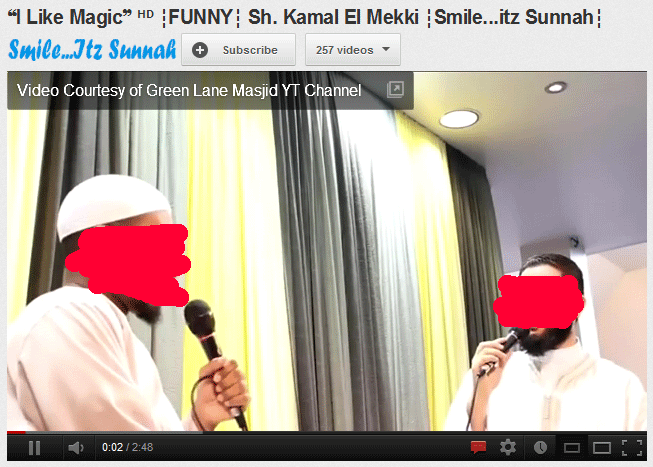
AlMaghrib Institute and Kamal el-Mekki Still Using Magic Openly to Sell Tickets to their Events

 In the Name of Allaah, the Most Gracious, the Ever Merciful…

After being exposed last year for using actual magic tricks (like levitation) to promote their expensive seminars and events, AlMaghrib Institute removed their official trailer called “Magic Tricks by Kamal el-Mekki”, not to repent, but to HIDE from criticism until the controversy died down. Their magician, “Shaykh” Kamal el-Mekki was exposed for promoting the magic of Criss Angel and Dynamo as perfectly halaal entertainment in events organized by Green Lane Masjid (Birmingham, UK), where he actually said:

I can show you every one of their tricks, how they do it, and every one of them has an explanation.

This was stated, word-for-word, in an interview conducted by Green Lane Masjid and uploaded on their official YouTube Channel. (Transcript)

Kamal el-Mekki boasts about how he knows all of the magic of some of the world's top illusionists, like Criss Angel and Dynamo.

Kamal el-Mekki claims to know all of the magic of some of the world’s top illusionists, like Criss Angel and Dynamo.

After this blatant promotion of magic reached the world and was exposed, Green Lane Masjid imam, Abu Usamah At-Thahabi, gave an entire Friday sermon against magic, accepting blame on behalf of the masjid’s administration for Continue reading

The “28-Day Ramadan” Mistake and the High Judiciary Council of Saudi Arabia

In the Name of Allaah…

A clear response by Moosaa Richardson to the blog, twitter, and facebook claims that the Saudi Government has done something to corrupt the Muslims’ month of Ramadan this year, 1434 (2013).

30 minutes of solid foundations to aid our brothers and sisters in understanding this pillar of our Religion according to the Messenger of Allah (may Allah raise his rank and grant him peace), including:

  • Islam is a perfect religion, one of ease that can be practiced by any human being, educated or uneducated.
  • Part of that perfect religion is fasting begun by a moon sighting according to the Book of Allah.
  • Starting a month is only done by a moon sighting or counting out 30 days according to the Sunnah.
  • The disobedience of those who fast on the 30th of Sha’baan without a moon sighting (thinking to play it safe because of cloud coverage), and their INVALID fasting.
  • The logical possibility of 28 days of fasting and how it has been dealt with throughout history.
  • Making up a day of fasting (qadhaa’) does not indicate that anything wrong was done.
  • The audacity of those who would accuse people who closely follow the orders of Allah and His Messenger (sallallaahu ‘alayhe wa sallam) of causing corruption and ruining people’s fasting, etc.
  • Ending the month of Ramadan spreading rumors and doubts is an indication of a failed month of worship (may Allah excuse us!)

Please spread it to help refute the many false rumors being circulated, may Allah reward you!

MP3: https://www.bakkah.net/en/wp-content/uploads/2013/08/saudi-court-moon-sighting-conspiracy-error-1434.mp3

Hadeeth Qudsee: “Neither My Earth nor My Heavens Could Contain Me…” [?]

In the Name of Allaah, the Most Merciful, the Ever-Merciful…

A hadeeth qudsee is a narration which is attributed to the Prophet (may Allaah raise his rank and grant him peace), that he narrated words from Allaah which are not part of the Quran. Unlike the Quran, these narrations have to be studied and authenticated before they can be accepted and acted upon.

One such narration commonly quoted and attributed to Allaah as His Words is as follows:

ما وسعني أرضي ولا سمائي، ووسعني قلب عبدي المؤمن…
“Neither My Earth nor My Heavens could contain Me, whilst the heart of My believing servant does contain Me…”

I found this hadeeth once while I was searching the manuscript archives at Umm al-Qura University. I came accross a title listed in one of the indexes on the topic of criticism of some unauthentic hadeeths in al-Bukhaaree and Muslim attributed to Ibn Taymiyyah. So I rushed to get the microfilm and print out a copy, thinking to have found some amazing treasure not known to even the scholars previously. When I began to read it, I found that it was actually a previously known work called “Ahaadeeth al-Qussaas (Hadeeths Used by Storytellers) by Ibn Taymiyyah, which has been printed already, and in fact it was even (for the most part) included in Ibn Taymiyyah’s large Fataawee Collection (18/122-128, 375-385).

What’s the connection? Well, the hadeeth qudsee in question is actually the first hadeeth mentioned in that book. About it, Ibn Taymiyyah said:

This is something they (storytellers) narrate from the Israa’eeliyyaat (narrations of the Jews and Christians). It has no known chain to the Prophet (may Allaah raise his rank and grant him peace). Its meaning would be (if it were authentic): His heart contains belief in Me, love of Me, and knowledge of Me.

Otherwise, anyone who would claim that Allaah Himself is present inside of the people’s hearts is more of a disbeliever than the Christians, who restricted that (Allaah’s actual presence within the creation) to the Messiah alone.

Other scholars of hadeeth, like al-‘Iraaqee, as-Sakhaawee, and Al-Albaanee Continue reading

List of Accepted Students at Imam University, Riyadh 1434-1435 (2013-2014)

In the Name of Allaah…

Imam Muhammad ibn Su’ood Islaamic University in Riyadh has just published the list of accepted students from all over the world for the upcoming academic year: 1434-1435 (2013-2014).

The Admissions Department publicized a list of 395 international scholarships, which includes students from all around the world, among them:

  • 6 Americans
  • 15 Britons (#23-30 and #241-247)
  • 28 Filipinos (#147-160 and #346-359)
  • 2 Canadians
  • 1 French

Source: Official published list from the university (PDF)

Contact Information for “Admissions” for Follow-up:

A current student may be able to volunteer some time to offer some help and guidance until the university opens (may Allaah reward him generously):

  • Email: Abdulhameed.ke at gmail dot com
  • Phone: (412) 961-2363 (USA)

We pray that Allaah blesses them all and grants them success in their studies.

About studying at Imam University (click here)

*NOTE: Riyadh has recently had its area code changed. The old area code was 01. The new one is 011.

Also, you will not likely receive any response from anyone at the university before the second week of Shawwaal (beginning August 18, 2013), due to the ‘Eed al-Fitr break.

Shaykh Ibn ‘Uthaymeen on Attending Classes While in I’tikaaf (Seclusion in the Masjid)

In the Name of Allaah, the Most Gracious, the Ever Merciful…

Some people may feel it is inappropriate to attend a class about Islaam while performing i’tikaaf (seclusion in the masjid), which is commonly done in the last ten nights of Ramadhaan.

Our shaykh, the great scholar, Muhammad ibn Saalih al-‘Uthaymeen (may Allaah have Mercy on him) posed and answered the following question:

*ﻭﻫﻞ ﻳﻨﺎﻓﻲ ﺭﻭﺡ ﺍﻻ‌ﻋﺘﻜﺎﻑ ﺃﻥ ﻳﺸﺘﻐﻞ ﺍﻟﻤﻌﺘﻜﻒ ﻓﻲ ﻃﻠﺐ ﺍﻟﻌﻠﻢ؟*

 Does it go against the spirit of i’tikaaf to occupy oneself with seeking knowledge?

*ﺍﻟﺠﻮﺍﺏ: ﻻ‌ ﺷﻚ ﺃﻥ ﻃﻠﺐ ﺍﻟﻌﻠﻢ ﻣﻦ ﻃﺎﻋﺔ ﺍﻟﻠﻪ، ﻟﻜﻦ ﺍﻻ‌ﻋﺘﻜﺎﻑ ﻳﻜﻮﻥ ﻟﻠﻄﺎﻋﺎﺕ ﺍﻟﺨﺎﺻﺔ، ﻛﺎﻟﺼﻼ‌ﺓ، ﻭﺍﻟﺬﻛﺮ، ﻭﻗﺮﺍﺀﺓ ﺍﻟﻘﺮﺁﻥ، ﻭﻣﺎ ﺃﺷﺒﻪ ﺫﻟﻚ، ﻭﻻ‌ ﺑﺄﺱ ﺃﻥ ﻳَﺤﻀﺮ ﺍﻟﻤﻌﺘﻜﻒ ﺩﺭﺳﺎً ﺃﻭ ﺩﺭﺳﻴﻦ ﻓﻲ ﻳﻮﻡ ﺃﻭ ﻟﻴﻠﺔ؛ ﻷ‌ﻥ ﻫﺬﺍ ﻻ‌ ﻳﺆﺛﺮ ﻋﻠﻰ ﺍﻻ‌ﻋﺘﻜﺎﻑ، ﻟﻜﻦ ﻣﺠﺎﻟﺲ ﺍﻟﻌﻠﻢ ﺇﻥ ﺩﺍﻣﺖ، ﻭﺻﺎﺭ ﻳﻄﺎﻟﻊ ﺩﺭﻭﺳﻪ، ﻭﻳﺤﻀﺮ ﺍﻟﺠﻠﺴﺎﺕ ﺍﻟﻜﺜﻴﺮﺓ ﺍﻟﺘﻲ ﺗﺸﻐﻠﻪ ﻋﻦ ﺍﻟﻌﺒﺎﺩﺓ ﺍﻟﺨﺎﺻﺔ، ﻓﻬﺬﺍ ﻻ‌ ﺷﻚ ﺃﻥ ﻓﻲ ﺍﻋﺘﻜﺎﻓﻪ ﻧﻘﺼﺎً، ﻭﻻ‌ ﺃﻗﻮﻝ ﺇﻥ ﻫﺬﺍ ﻳﻨﺎﻓﻲ ﺍﻻ‌ﻋﺘﻜﺎﻑ.* 

The answer: No doubt that seeking knowledge is an act of obedience to Allaah. However, i’tikaaf has more to do with specific acts of obdedience, such as prayer, remembrance, recitation of Quran, etc. There is no problem if the one performing i’tikaaf attends a lesson or two during the day or night, as this does not affect the (validity of) i’tikaaf.

However Continue reading

Ibn al-Qayyim Explains the Disbelief of Ibn Sina (Avicenna)

In the Name of Allaah, the Most Gracious, the Ever Merciful…

Since the publication of our article, The Reality of Ibn Sina (Avicenna), Famous Scientist and Philosopher, many people have been asking for more detailed proofs that Ibn Sina was not actually a Muslim, specifically from his own beliefs.

This article provides more detailed proof about his specific beliefs from the writings of one of the most amazing scholars in Islamic history, Ibn Qayyim al-Jowziyyah (d.751), may Allaah have Mercy on him.

After Ibn al-Qayyim mentioned that Aboo Nasr al-Faaraabee (or Al-Farabi), like Ibn Sina, was upon an extreme deviation of the concepts promoted by Aristotle, including disbelief in Allaah, His Angels, His Books, His Messengers, and the Last Day, he went on to say:

Perhaps an ignorant person might say that we have dealt too harshly with them, ascribing them to disbelief in Allaah, His Angels, His Books, and His Messengers. This is not far-fetched for someone who is ignorant of both their writings and the reality of true Islaamic teachings.

[Disbelief in Allaah]

You should know: According to the teachings of the best of the modern philosophers, their voice, and their role model whom they prefer over the Messengers themselves, Aboo ‘Alee Ibn Sina, Allaah – Glorified and Exonorated above their claims – is merely one who exists in a general way, without having a single attribute, nor any chosen actions at all. He does not know anything about the universe at all. He does not know how many planets there are, nor does he know anything of the unseen. He does not speak, nor does He have any attribute at all (in their beliefs).

It should be clearly known that this concept is (that Allaah is) just an imaginary idea in one’s mind, having no reality. Its most apparent manifestation of this is when a person thinks of it and defines it in his mind, as he would imagine other theoretical concepts. This is certainly not the Lord to whose Way the Messengers called, the One whom the previous nations knew of.

The real Lord of the universe, the God of the Messengers, is clearly not this “lord” whom the heretics call to, stripping him of any real presence and any attribute or action, claiming he is neither part of the universe, nor beyond it, nor having any connection at all to it, nor being seperate from it, nor being in front of it or above it, nor on the left or right, etc. The difference between the two is like the difference between existence and non-existence, like the difference between affirming something and negating it (i.e. complete opposites)!

In fact, anything that could possibly exist would be more complete than this “god” who the heretics call to, the one their intellects have carved, while real carved idols have a real existence and this “lord” does not. He can only exist within the imagination!

All of this is the case, while these heretics are more correct Continue reading

Shaykh Saalih Aal ash-Shaykh on Asking the Dead to Intercede

In the Name of Allaah, the Most Gracious, the Ever Merciful…

This is an answer given by Shaykh Saalih Aal ash-Shaykh to the issue of requesting the supplication of the deceased. The shaykh was asked (during his explanation of al-‘Aqeedah at-Tahaawiyyah, in the printed version: 2/1029, Dar al-Mawaddah, Egypt):

من سأل النبي صلى الله عليه وسلم أن يدعو له وأن يطلب له المغفرة من الله بعد موته، هل هذا شرك؟

The one who asks the Prophet (may Allaah raise his rank and grant him peace) to supplicate for him and to ask for his forgiveness from Allaah after his (the Prophet’s) death, is this shirk (an act of polytheism)?

The shaykh’s answer:

نعم، هو شرك أكبر لأن النبي صلى الله عليه وسلم لا يُدعى بعد موته، فطلب الدعاء من الميت، وطلب الدعاء بالإغاثة أو الاستسقاء؛ يعني أن يدعو الله أن يغيث، أو أن يدعو الله أن يغفر، أن يدعو الله أن يعطي ونحو ذلك، هذا كله داخل في لفظ الدعاء والله – عز وجل – قال {وَأَنَّ الْمَسَاجِدَ لِلَّهِ فَلَا تَدْعُوا مَعَ اللَّهِ أَحَدًا} [الجن:18].

Yes, it is major shirk because the Prophet (may Allaah raise his rank and grant him peace) is not to be called upon after his death. Requesting supplication from the dead  (for them to) request rescue and sending of rain, meaning, that he (the deceased) supplicates to Allaah that He grants relief or he supplicates to Allaah to forgive (the person making the request), that he supplicates to Allaah to give (to that person) and what is like this, all of it is included in the meaning of the word “du’aa” (supplication), and Allaah, the Mighty and Majestic said, “And the mosques are for Allaah, so do not invoke anyone alongside Allaah” [72:18].

 والذي يقول إنّ هذه الصورة وهي طلب الدعاء تخرج عن الطلب الذي به يكون الشرك شركًا فإنه ينقض أصل التوحيد كله في هذا الباب، فكل أنواع الطلب؛ طلب الدعاء يعني طلب الدعاء من الميت، طلب المغفرة من الميت، أو طلب الدعاء من الميت أن يدعو الله أن يغفر، أو طلب الإغاثة من الميت أو طلب الإعانة أو نحو ذلك كلها باب واحد هي طلب، والطلب دعاء فداخلة في قوله تعالى {وَمَنْ يَدْعُ مَعَ اللَّهِ إِلَهًا آخَرَ لَا بُرْهَانَ لَهُ بِهِ فَإِنَّمَا حِسَابُهُ عِنْدَ رَبِّهِ إِنَّهُ لَا يُفْلِحُ الْكَافِرُونَ} [المؤمنون:117] ، وفي قوله {وَأَنَّ الْمَسَاجِدَ لِلَّهِ فَلَا تَدْعُوا مَعَ اللَّهِ أَحَدًا} ، وفي قوله {وَالَّذِينَ تَدْعُونَ مِنْ دُونِهِ مَا يَمْلِكُونَ مِنْ قِطْمِيرٍ} [فاطر:13] ، ونحو ذلك من الآيات.

And the one who says that this form, which is to Continue reading

The Reality of Ibn Sina (Avicenna), Famous Scientist and Philosopher

In the Name of Allaah, the Most Gracious, the Ever Merciful…

The famous fifth-century medical expert and philosopher, Ibn Sina, known to the West as “Avicenna”, is often credited as being one of the greatest Muslim scientists in history. His name is a celebrated one in many Muslim circles, and even hospitals and institutions of learning are named after him out of respect and admiration for his achievements.

While many Muslim scientists throughout history truly did pioneer many important medical and scientific breakthroughs, Muslims need to step back and re-examine what they have been led to believe about Ibn Sina specifically – Is it factually correct? Was he even a Muslim?

Shaykh al-Islaam Ibn Taymiyyah on Ibn Sina

Aboo ‘Alee Al-Husayn ibn ‘Abdillaah ibn al-Hasan ibn ‘Alee ibn Sina (d.428) was born to a severely deviant Ismaa’eelee (Shiite) family, known for their severe blasphemy and hypocrisy, as mentioned by Shaykh al-Islaam Ibn Taymiyyah.[1] In fact, as Ibn Taymiyyah said:

وأحسن ما يُظهرون دين الرفض وهم في الباطن يُبطنون الكفر المحض

“The best thing they showed openly was ar-Rafdh (being Raafhidah Shiites), while they concealed pure, absolute disbelief inwardly.” [1]

Ibn Taymiyyah confirmed this by mentioning that Ibn Sina himself identified his own family, his father, and his brother to all be from this severely deviant group that was exposed and declared outside of Islam by many scholars.

Ibn Taymiyyah further detailed how Ibn Sina attempted to blend what he learned from the deviant claimants to Islam, the Mu’tazliah and Raafidhah, with the polytheistic philosophy of Aristotle, and when he did so he deviated even further, Continue reading

Shaykh ‘Abdul-‘Azeez ar-Raajihee on Those Who Consider Ibn Sina to be a Muslim

In the Name of Allaah, the Most Gracious, the Ever Merciful…

Shaykh ‘Abdul-‘Azeez ar-Raajihee (may Allaah preserve him) was asked:

Question: With respect to the proper understanding of the issue of people who do not hold the polytheists to be disbelievers, such as Ibn Sina (Avicenna), if a person comes along and says, “I do not hold Ibn Sina to be a disbeliever. He is a Muslim to me.” Has this person committed disbelief?

Answer: If he is confused about him and is not aware of his condition, he does not commit disbelief until his (Ibn Sina’s) affair is first made clear to him. However, someone who knows he was a disbeliever and a heretic, yet does not declare him to be a disbeliever, falls under this nullifier of Islaam (i.e. he is no longer a Muslim). This may not be clear to some people, however, so the one who is not aware of his condition should be made aware of it.

Question: [Continuing…] But if he rejects this and says, “I am not required to do this”?

Answer: He IS required to do this. This means that he has fallen into one of these nullifiers of Islaam: “Whoever does not consider the polytheists to be disbelievers, or has doubts about their disbelief or considers their ways and beliefs to be correct, then he has committed disbelief.”

You are required to hold the polytheists as disbelievers and have enmity and hatred for them for the sake of Allaah. Allaah has required this Continue reading

Shaykh Saalih al-Fowzaan on Loving and Hating for the Sake of Allaah

In the Name of Allaah…

Recently, the great scholar, Shaykh Saalih ibn Fowzaan al-Fowzaan (may Allaah preserve him) was asked:

What is the ruling on rejecting the idea of hatred for the sake of Allaah and claiming that it is not from Islam? Is a person’s Islaam valid if he does not hate the Jews and Christians?

The shaykh responded:

Walaa’ and baraa’ (the islamic system of loyalty) is a must. (It is) disallegiance with the enemies of Allaah and loyalty to the allies of Allaah. Walaa’ and baraa’ means to have hatred, declaring oneself free of them (the disbelievers) and their religion, this is baraa’.

Walaa’ means to love Allaah, to love His Messenger, and to love His believing servants, take them as allies and come to their defense.

“Indeed you have a good example in Ibraaheem (Abraham) and those with him, when they said to their people: We are free of you and all that you worship beside Allaah…” [Meaning of Quran 60:4]

They declared themselves free of them and their idols, their objects of worship.

“…We are free of you and all that you worship beside Allaah. We have disbelieved in you (i.e. your religion), and there shall be enmity and hatred between us forever, unless you believe in Allaah alone.” [Meaning of Quran 60:4]

Thus it is not permissible to love the disbelievers. Whoever takes them as allies, Allaah, the Mighty and Most High, has said [what means]:

“O you who believe! Do not take the Jews and Christians as allies! They are allies of one another. Whoever takes them as allies is indeed from them. Verily Allaah does not guide people who are oppressive.” [Meaning of Quran 5:51]

The issue is very serious. Walaa’ (loyalty) and baraa’ (disallegiance) are Continue reading

Referring to the Quran as a Form of “Music” or Describing it as “Musical”

In the Name of Allaah, the Most Gracious, the Ever Merciful…

From the unique writings of the late scholar, Shaykh Bakr Aboo Zayd (may Allaah have Mercy on him), is a beneficial 700-page dictionary of “bad language” called “Mu’jam al-Manaahee al-Lafthiyyah” in which he identified and refuted incorrect, inappropriate, and/or impermissible words and phrases that some people use.

In this book (p.117), he included how some people refer to the Quran as “music” or “musical”, or having musical tones or rhythms, and commented:

These are unacceptable descriptions because of three issues:

[1] This is claiming a likeness between Quranic Verses and impermissible musical instruments.

[2] Music is an art form that draws people into disobedience and wickedness, so how could it resemble the Magnificent Quran, the Speech of the Lord of all the worlds, that which guides to eemaan (statements, actions, and beliefs of faith) and the Straight Path?!

[3] Allaah the Exalted has refuted the idea of the Quran being poetry and exonerated it above that (claim), so how could it (the Quran) then resemble the voices and instruments of musicians?! (something far worse)

As the Arabs who have picked up these kinds of repugnant phrases from books that the scholars have been warning against (like Sayyid Qutb’s “Thilaal” for example), it is also hoped that Continue reading

Do not Disregard the Moonsighting to Rely on Calendars for the Beginning and End of Ramadhaan

In the Name of Allaah, the Ever Merciful, the Most Merciful…

All Muslims concerned with following the Quran and Sunnah properly should be advised that it is not permissible to plan the first day of Ramadhaan based solely on calendars and the scientific predictions behind them.

This is because Allaah has legislated fasting to begin with the sighting of the crescent of Ramadhaan or the completion of 30 days of Sha’baan when the crescent is not visible.  His Messenger (may Allaah raise his rank and grant him peace) said, quite clearly:

لا تصوموا حتى تروا الهلال ولا تفطروا حتى تروه

“Do not begin fasting until you sight the moon, and do not break your fast (for ‘Eed) until you have sighted it.” (Bukhari & Muslim)

Since Monday will be the 29th of Sha’baan, Ramadhaan 1434 will begin on either Tuesday (July 9, 2013) or Wednesday (July 10, 2013), depending on whether or not the moon is sighted.

Please be advised that any people claiming at this time that Ramadhaan will begin on a pre-specified day are people who are inviting you to leave the clear practice of fasting according to the Book and the Sunnah.

Please take the time to read the following official verdict of the Permanent Committee of Scholars on the topic if you are not entirely clear on the Islaamic rulings related to this matter:

http://www.alifta.net/Fatawa/FatawaChapters.aspx?languagename=en&View=Page&PageID=30&PageNo=1&BookID=10

May Allaah bless the Muslims and unite them upon the Book of their Lord, the Sunnah of His Messenger (may Allaah raise his rank and grant him peace), and the way of the Companions and early Muslims who practiced it purely.

NOTE: Do not allow the legitimate scholarly differing over the issue of “local” vs. “global” moonsighting to be grounds for anyone to introduce any concept they choose – like rejecting the entire concept of moonsighting altogether!

And Allaah knows best.

Written by: Moosaa Richardson

Acts of Misplaced Loyalty: Following the Non-Muslims’ Calendar

In the Name of Allaah, the Most Gracious, the Ever Merciful…

In his discussion of the various impermissible ways some Muslims show misplaced loyalty and allegiance to the non-Muslims, senior Islamic scholar Shaykh Saalih ibn Fowzaan al-Fowzaan (may Allaah preserve him) states:

#6 – Keeping track of the date using their calendars, especially those that highlight their rituals and holidays, like the Christian (Gregorian) Calendar

It (the Gregorian Calendar) is something that commemorates the birth of the Messiah (may Allaah grant him peace), and something which they invented themselves, not something from the Religion of the Messiah (may Allaah grant him peace). Using this calendar includes sharing with them in the preservation of their rituals and holidays.

To avoid this, the Companions (may Allaah be pleased with them) wanted to establish a calendar for the Muslims in the time of ‘Umar, the (second) Caliph. They ignored the previously established calendars of the disbelievers and began with the Messenger’s emigration (i.e. his hijrah to the city of al-Madeenah).

This proves the obligation to oppose the disbelievers in this and all other things which are specific to them, and Allaah is the One from whom we seek help.

Source: Al-Walaa’ wal-Baraa’ (pp.11-12), Daar al-Imaam Ahmad printing, 1434.

Important Notes:

[1] The English names of some of the months on the Gregorian Calendar have polytheistic origins rooted in Greek, Roman, and other mythology:

Shaykh al-Fowzaan Exposes the Plots to Defame Scholars by Calling Them “Madkhalees” and “Jaamees”

In the Name of Allaah, the Most Merciful, the Ever Merciful…

Shaykh Saalih ibn Fowzaan al-Fowzaan, one of today’s most widely respected scholars of Islaam – may Allaah preserve and protect him – , was asked about people who resort to name-calling with labels like “Madkhalees” and “Jaamees”, and he replied:

Stop these kinds of affairs and this name-calling. Do not insult each other with name-calling. Allaah, the Mighty and Most High, has commanded you:

ولا تنابزوا بالألقاب

Do not insult each other with name-calling! [49:11]

You are all brothers [addressing students al-Madeenah University], all of you are upon the same religion. You are all peers, and to Allaah is the praise. Drop these affairs, and show respect for the scholars. Respect the scholars! Whoever does not respect the scholars shall remain deprived of their knowledge. He will be deprived of being able to benefit from them.

Abandon this thing – the name-calling and speaking ill of the scholars – those who have virtue and status over the rest of the people which Allaah bestowed upon them:

يرفع الله الذين آمنوا منكم والذين أوتوا العلم درجات

“Allaah raises the believers among you and the people given knowledge many degrees.” [58:11]

The scholars have their status, they have their ranks that are to be respected. If the scholars are Continue reading

From the Signs of the Last Day: Long Friday Khutbahs (Sermons) with Short Prayers

In the Name of Allaah, the Most Gracious, the Ever Merciful…

Shaykh Hammood ibn ‘Abdillaah at-Tuwayjiree (d.1413) – may Allaah have Mercy on him – said:

Long Khutbahs (Sermons) with Short Prayers: On this topic, there is the hadeeth of Ibn Mas’ood – may Allaah be pleased with him – who said:

You people are living in a time wherein prayers are made long, khutbahs (sermons) are short, there are many scholars, but few orators. A time will come upon the people when the prayer will be short, the khutbah will be long, a time of many orators but few scholars…

It was collected by at-Tabaraanee, and al-Haythamee said: Its narrators are those of the Saheeh (hadeeth collections of al-Bukhaaree and/or Muslim).

It was also collected by Imaam Maalik in his Muwatta’, with a similar wording:

…And the people shall encounter a time when the scholars of fiqh are few, but the reciters are many, the letters of the Qur’aan will be memorized, but the rulings will be lost, many shall be asked questions (about Islaam), few will be able to benefit anyone, they shall prolong khutbahs (sermons), and shorten the prayers. Their whims will become evident even before their actions.

…He (Ibn Mas’ood) – may Allaah be pleased with him – also narrated from the Prophet (may Allaah raise his rank and grant him peace) that he said:

إن قصر الخطبة وطول الصلاة مئنة من فقه الرجل، فأطيلوا الصلاة، واقصروا الخطبة، فإن من البيان سحرًا، وإنه سيأتي بعدكم قوم يطيلون الخطب ويقصرون الصلاة

“Verily, a short khutbah and a long prayer is a sign of a man’s fiqh (religious understanding), so lengthen the prayer and shorten the khutbah, as surely some types of speech are magical. People will come after you who prolong the khutbahs and shorten the prayers.”

It was collected by al-Bazzaar, and part of it was Continue reading

Shaykh Ibn Baaz: The Raafidhah Cult (of Iran) are the Most Dangerous of all the Innovators

In the Glorious Name of Allaah, the Ever Compassionate, the All Merciful…

The modern state of Iran is officially an Ithnaa’ashariyyah (Twelver Shiite) state, where 90-95% of the people there are Twelvers, also known as Raafidhah, Imaamiyyah, or Ja’faree Shias.

Shaykh ‘Abdul-‘Azeez ibn Baaz (may Allaah have mercy upon him) identified this specific sect as the most dangerous of all Shia sects. He said:

…The Shiites have many different sects, each one having a variety of deviations. The most dangerous of them is the Khomeinian Raafidhah Twelver Sect (the official religion of Iran), due to the large number of their missionaries and all the major acts of polytheism found in it, like seeking help from the (deceased) Prophetic family members, believing them to have knowledge of the Unseen, especially the twelve imams, as they claim. This is also due to their expelling the majority of the Companions from the Religion and their abusive speech toward them, the likes of Aboo Bakr and ‘Umar (may Allaah be pleased with them). We ask Allaah for safety from the falsehood they are upon…

Source: His Fatwaa Collection (4/439). (Arabic)

Shaykh Ibn Baaz was also asked about the concept of Ahlus-Sunnah coming together with the Raafidhah Shiites. He replied:

It is not possible for Ahlus-Sunnah to come together with the Raafidhah, because the ‘aqeedah (belief system) is different. The basic belief of Ahlus-Sunnah wal-Jama’ah is to worship Allaah alone – the Glorified and Most High – , singling Him out in all acts of worship. No one may be called upon other than Him, not an angel high in status, nor a prophet dispatched (by Allaah Himself). Furthermore, only Allah – the Glorified and Most High – knows the Unseen.

From the belief system of Ahlus-Sunnah wal-Jamaa’ah is Continue reading

Shaykh Ibn Baaz on Giving a Mus-haf to a Christian

In the Name of Allaah, the Compassionate, the Ever Merciful…

Shaykh ‘Abdul-‘Azeez ibn Baaz (may Allaah have Mercy on him), late Muftee of Saudi Arabia, was asked, “If a Christian requests a mus-haf from me, should I give it to him or not?” He replied:

You may not give him one, however, you can read the Qur’aan to him, so he could hear it. You could invite him to (the Religion of) Allaah and pray for his guidance, based on the Statement of Allaah, the Most High, in His Authoritative Book [what means]:

( And if any of the polytheists seek your protection, then grant him protection, so that he could hear the Speech of Allaah, then grant him passage safely. ) [9:6]

And the statement of His Messenger (may Allaah raise his rank and grant him peace) [what means]:

“Do not travel with the Qur’aan to the land of the enemy, as I fear they could get a hold of it.” [Muslim]

This proves that a non-Muslim is not to be given a mus-haf, to avoid him degrading it or playing with it. However, he can be taught, have the Qur’aan read to him, advised, and prayed for. If he accepts Islam he can be given a mus-haf.

Furthermore, there is no problem in giving him some books of tafseer or hadeeth, if it is hoped that he might benefit from them. He may also be given some translations of the meanings of the Noble Qur’aan.

Source: Majmoo’ Fataawaa of Shaykh Ibn Baaz (6/469-470). [Arabic]

Translated by: Moosaa Richardson

Regarding the Claimed Contradictions of Shaykh Rabee’ in Jarh and Ta’deel

In the Name of Allaah, the All Compassionate, the Ever Merciful…

[Read the complete PDF version of this article]

We’ve seen for years people criticizing the likes of Shaykh Rabee’ ibn Haadee al-Madkhalee (may Allaah preserve him), regarding the claim that he is not upon the way of the early critics of the Salaf – the likes of Imaams Ahmad ibn Hanbal and Yahyaa ibn Ma’een. And what they say: “His ‘foolishness’ of lavishly praising people and then abandoning them has excluded him from resembling the critics of old, and it shows that he is ‘unstable’ and his statements in criticism of people are ‘not reliable’.”

Let us begin with understanding something in this issue so that we don’t pass on and parrot things without understanding them.

True Academic Criticism in Islaam

In academic criticism in Islaam – as understood by the scholars of Jarh wa Ta’deel throughout history (النقد العلمي) [Academic criticism] – No one is beyond criticism, no one is immune from criticism, other than those who have gained immunity from Allah, i.e. they have been praised in the Qur’aan and they have been sanctified by the Book of Allah or by the revelation given to Muhammad (صلى الله عليه وسلم), i.e. his Sunnah. Aside from that, the narrators, the teachers, the callers, the scholars themselves – all of them are subject to criticism. As one of the greatest of the scholars, al-Imaam Maalik, is so commonly quoted as saying:

مَا مِنَّا إِلاَّ رَادٌّ وَمَرْدُودٌ عَلَيْهِ

Meaning: Every single one of us (every scholar) is either criticizing / refuting, or being criticized / refuted.

That is the case of the scholars, and, of course, every writer and every caller is subject to criticism. The criticism of the scholars of Islaam is ongoing, it is mutajaddid [continuously updated], it is renewed, and it is revisited, at every possible occasion. No one from the critics of Islaam had ever Continue reading

Shaykh Saalih Al-Fowzaan Appears On TV, So Does He Believe Video Recordings Are Permissible?

In the Name of Allaah…

Some people have assumed that since Shaykh Saalih al-Fowzaan, one of today’s leading Islamic scholars, appears on TV, then he must have changed his views on videography (recording video images) and even still photography as well.

The shaykh (may Allaah preserve him) has been approached and asked about this concern more than once. He was asked once:

What is the ruling on videography? And how should we respond to those who say you consider it permissible based on your appearances on TV and on the Majd Channel?

The shaykh replied:

Subhaan Allaah (Glorified be Allaah)! I have allowed this?! Regarding the (TV) appearances, then I have not sought to appear (on TV). Rather, they came out and attended the masjid. They recorded the lecture and the attendees. They are the ones who did that, without seeking permission or consultation. I have not allowed this, nor am I pleased with it for anyone.

They also recorded Ibn Baaz, may Allaah forgive (them), while he was not pleased with it and warned against it. They come to events and gatherings and record, and the images appear on TV. Does this mean that Shaykh Ibn Baaz allowed tasweer (recording images)? In no way whatsoever! He died Continue reading

From the Joys of Paradise: Sexual Intercourse

In the Name of Allaah, the Most Merciful, the Ever Merciful…

Allaah, the Most Generous, has promised His believing servants many different rewards in His expansive gardens of Paradise.  Aside from the greatest joy of all, looking at our Magnificent Creator, the residents of Paradise will indulge in various foods an drinks, to the large homes, rivers of pure water, honey, milk, and wine, to the beautiful virgin girls awaiting the personal enjoyment of the men.

Deviant Modernists Second Guess Allaah’s Divine Wisdom

Recently, philosophical attempts have been made to rationalize some of these rewards and second guess the Divine decree of Allaah, as deviants begin picking and choosing what is acceptable from Allaah’s perfect Wisdom and what is not. Some people – affected by a Christian understanding of the Hereafter – have actually begun denying some of the things promised by Allaah in His Book and explained in detail by the Messenger of Allaah (may Allaah raise his rank and grant him peace), like continual acts of sexual intercourse with the hoor ‘een (pure virgin maidens) of Paradise.

Christian Influence

According to both modern and ancient Christian misconceptions revolving around the “dirty” and “disgraceful” nature of legal sexual intercourse, they believe that it is not the ambition of an upright person. Based on this, they exonerate their religious leaders above such a lowly concept in this life, and they reject the “repulsive” concept of sexual pleasures in Paradise.  In the Hereafter, they deny any type of sexual intercourse, claiming that Paradise is a “pure place” above such Continue reading

Common Mistakes: Replacing the Father’s Name or the Family Name

In the Name of Allaah, the Most Merciful, the Ever Merciful…

A common mistake made in the West is when new Muslims are instructed to change their family names, or to change, replace, or abandon their fathers’ names. For example, a new Muslim named “Joe Smith”, whose father’s name is Michael, may be advised to change his name to “Abdullaah Muhammad al-Amreekee”. Often, without the right guidance, a new Muslim may be inclined against his family’s name and want to free himself of it. He may even feel this is required or encouraged in Islam!

In reality, from the most basic human needs preserved in all the divine religions throughout history is the preservation of the people’s ancestry. Islam, as the culmination of all previous revelations, gives this matter the utmost urgency, as our Lord orders us:

ادْعُوهُمْ لِآبائِهِمْ هُوَ أَقْسَطُ عِنْدَ اللَّهِ

“Call them by their fathers’ (names), it is more just with Allaah” [33:5]

A Muslim is required to keep his father’s name, as well as his family name. This Islaamic manner of naming is so important that the Messenger of Allaah (may Allaah raise his rank and grant him peace) warned those who replace their fathers’ names with a very serious consequence:

مَنِ ادَّعَى إِلَى غَيْرِ أَبِيهِ، وَهُوَ يَعْلَمُ أَنَّهُ غَيْرُ أَبِيهِ، فَالْجَنَّةُ عَلَيْهِ حَرَامٌ

“Whoever ascribes himself to someone other than his (real) father, knowing that he is not his (real) father, Paradise is forbidden for him!” [al-Bukhaaree and Muslim]

We see clearly that changing one’s name in a way that replaces the father’s and/or family’s names with other names is absolutely forbidden, and we must Continue reading

Pork By-Products in Food, Medicine, or Cosmetics

In the Name of Allaah, the Most Merciful, the Ever-Merciful…

The Permanent Committee of Scholars in Saudi Arabia was asked a question about foods, medicines, and cosmetics containing pork and pork by-products, like fat, oil, hair, or bones (crushed into powder).  They replied:

When a Muslim knows with certainty or near-certainty that pork, fat from the pig, or crushed pig bones are found in any type of food, medicine, toothpaste, or the likes, it is not permissible to eat, drink, or wipe it (on one’s body). And he is to leave whatever he is uncertain about, due to his statement (may Allaah raise his rank and grant him peace):

دع ما يريبك إلى ما لا يريبك

Leave that which makes you doubt for that which does not make you doubt.

And through Allaah is success.  May Allaah raise the rank of our Prophet Muhammad, and that of his family and companions, and grant them all peace.

[Shaykh] ‘Abdullaah ibn ‘Qu’ood
Member

[Shaykh] ‘Abdullaah ibn Ghudayyaan
Member

[Shaykh] ‘Abdur-Razzaaq ‘Afeefee
Vice Chairman

[Shaykh] ‘Abdul-‘Azeez ibn ‘Abdillaah ibn Baaz
Chairman

Source: Verdicts of the Permanent Committee (22/281).

Translated by: Moosaa Richardson

Regarding Those Who Say Hatred is Not From Islam (Shaykh ‘Abdur-Rahmaan Muhyiud-Deen)

In the Name of Allaah, the Most Merciful, the Ever Merciful…

Question: A well-known preacher in the West says: Islaam does not require anyone to hate any of the people. He also says: I do not want a religion that requires me to hate some people. This understanding has spread, and some of the Muslims have adopted it. What is your advice to the one who said this and to those Muslims who have followed him?

Answer by Shaykh ‘Abdur-Rahmaan Muhyiud-Deen, Former Professor at the Islamic University of al-Madeenah and Mufti at the Prophet’s Masjid (may Allaah preserve him):

This poor, misguided person does not know about Islaam. Someone who says that Islam does not include any hatred, and (this includes) that it does not include love either, since love and hatred [are inseparable]… This is Liberalist philosophy. The Shaytaan (Devil) has spoken upon this person’s tongue when he said there is no hatred, since there would be no love either, as a logical result. Impossible. You must hate disbelief and its people. You detest disbelief and its people. Could you watch the cross being worshipped and say: Be happy, there’s nothing (wrong) with that, or it’s nothing?! He would either be happy, or say there is nothing wrong. There is absolutely something wrong here, why is that? Because everything that is worshipped besides Allah is an enemy to Allaah! All of mankind are required to worship Allaah, ( O Mankind! ) What? [Students reply, ( Worship your Lord ).] [2:21]

It is a must to love Allaah: ( You do not find any people who Continue reading