
In the Name of Allah, the Most Gracious, the Ever Merciful…
As the hearts look forward to the month of Ramadhaan and all the goodness our Lord brings us within it, it can be noted that sometimes we behave with some level of heedlessness about dunyaa (worldly) matters, which might lead to considerable harm to ourselves, our family, and/or our entire Muslim community. This article addresses one such concern about food safety.
Whether you host a gathering at your home, help serve catered food at an Islamic center, or get involved in any level of serving food, you should know about the most recent guidelines by food safety experts regarding the preservation and storage of leftovers.
THE DANGER ZONE
USDA guidelines are based on scientific studies of how fast bacteria develops and grows in foods left at certain temperatures. One of the most important of those guidelines is the two-hour rule. Foods left out for serving without any warming device should be stored within two hours. Studies shows that after two hours, when food is left out in the danger zone, i.e., between 40° F and 140° F, bacteria within it grows much more rapidly, in a way that can be hazardous to our health, especially for our children, elders, and those more sensitive or vulnerable!
Bacteria grow rapidly between the temperatures of 40° F and 140° F. After food is safely cooked, hot food must be kept hot at 140° F or warmer to prevent bacterial growth. Within 2 hours of cooking food or after it is removed from an appliance keeping it warm, leftovers must be refrigerated. Throw away all perishable foods that have been left in room temperature for more than 2 hours (1 hour if the temperature is over 90° F, such as at an outdoor picnic during summer).
Source: Leftovers and Food Satefy (USDA)
I strongly advise that we give careful consideration to the following matters:
1. These are government guidelines, based on scientific analysis of empirical data, not simply “What So-and-So has been doing for years…,” and, “Nobody got sick…,” etc., claims that are not based on any actual follow-up or study, just whimsical claims. Community leaders need to take these issues very seriously and not dismiss them based on “what we’ve been doing” or other claims.
2. Muslims are not just sincere people of community service. They also put knowledge before their statements and actions. They combine their trust in Allah with taking the well-known and established steps of safety and caution. Knowledge of dunyaa matters is necessary to establish good, sound, healthy community service, avoiding harm as Allah has legislated.
3. Sometimes our cooked foods enter the “danger zone” (falling below 140° F) before they even arrive at the Islamic center or wherever they will be served from. Perhaps it was piping hot when we put it in the serving tray or took it out of the oven. Yet, sometimes that was two hours before it is actually served, and it has already been in the danger zone (between 40° F and 140° F) for over an hour before it is even served!
4. Using warming trays or hot surfaces to keep foods above 140° F has been made easy, wal-hamdu lillaah. At the end of this article, you will find some links to products on Amazon that can help us get our gatherings up to code and safe for all, by Allah’s Permission.
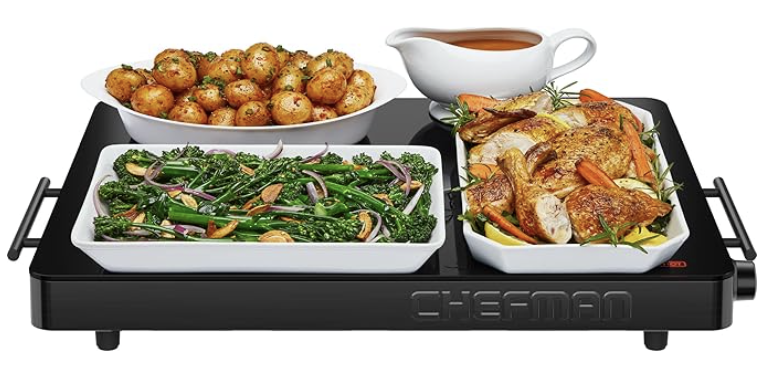
5. Sometimes, we bring food to our Islamic center about an hour before Maghrib, to attend a class before iftaar and then break our fast together. Quite commonly, that food continues to sit out at room temperature, without any warming tray, for hours, even until after the Taraaweeh Prayer. This might be four to six hours in total! Food left out in the danger zone (between 40° F and 140° F) is dangerous to consume and potential harmful. Instead of this food being thrown out to keep people safe, it might even be stored and heated for the next day!
Allah knows best how many times our good intentions combined with ignorance of (or resistance to) these important safety standards have actually caused significant harm and illness in the form of food poisoning or other serious issues.
Other issues of food safety that we should also consider:
- Those who cook at home should know about safe food handling procedures, cross contamination, safe cooking temperatures, etc.
- Ensuring that our refrigerators and freezers are maintained at the right temperatures.
- Clearly labelling containers with the date of refrigeration or freezing.
- Ensuring that containers are properly sealed.
- Reheating stored foods to adequate temperatures before serving as leftovers.
- Not putting the harm and concern of wasting food over the harm of making Allah’s worshippers sick. (Fiqh means to accurately assess harms when they clash and give priority to avoiding what is more harmful.)
I ask Allah to bless and reward all responsible community servants, those who come together to support their brothers and sisters and feed them in these virtuous times. Let us be sure to combine sincerity in intention with precision in application, as Allah has prescribed proficiency in all matters! And Allah knows best.
Written by: Moosaa Richardson (1447.08.23)
With contributions from the Patreon team (may Allah reward them well)
Related article: Top Ten Products That Can Help Our Community Maintain Essential Food Safety Standards
جَزَاكَ ٱللَّٰهُ خَيْرًا
Shaykh
A much needed reminder to the various Muslim communities as we often do not think of the health hazards of not warming or Cooking food properly.
May Allah reward you
Jazaakallahu Khairn for on of the “Most Important” reminders of this month. As a Culinary Professional we know what the know not when it comes to cooking for self or the masses. I thank for putting this piece together for the people can be educated when it comes to the process of handling the food. Alhamdulillah the reminder benefits the believers.