
We encourage your feedback through the “Comments” feature here on Bakkah.net. Use this feature to:
- Ask a brief follow-up question on the topic.
- Support the content of the article with a real example or application.
- Criticize the article or its translation (academically).
- Show a different point of view from other scholars.*
- Share a link (from reliable websites) to related information.
- Report a mistake in the article.
Please do not use the “Comments” feature to:
- Thank us for the article and/or make du’aa’ for us.**
- Ask for personal advice or assistance.**
- Promote Covid-19 misinformation or conspiracy theories.*
- Apply to a university [!], or request information or applications.
- Cut & paste lengthy articles on the same topic.
- Comment or ask questions in other languages (other than English).
- Post or request personal contact information.
These guidelines have been set in place to ensure that comments contribute something valuable to the article and enrich the quality of the content here at Bakkah.net, by Allah’s Permission.
Please note that this website is not an open discussion forum, and we reserve the right to moderate comments in a way that we hope is pleasing to Allah alone. We further advise that you have good thoughts about us and that you do not frustrate yourself in over-thinking the issue if your question was edited for clarity, delayed in approval, or not published at all.
Typically, comments and questions are approved and replied to after anywhere from a day later, to up to a month or more. This is because our resources are limited. Please forgive us for falling short and not providing a better service. May Allah bless you!
Bakkah.net Administration
NOTE: We do not accept applications on behalf of any universities or institutions of learning in the first place, nor have we ever offered this service.
*Regarding issues related to the Covid-19 Pandemic specifically, we are limiting the discussion to the speech of the senior scholars, and whatever will aid its dissemination with clarity, as the issue is extremely serious, and misinformation can lead to serious harm, in accordance to this:
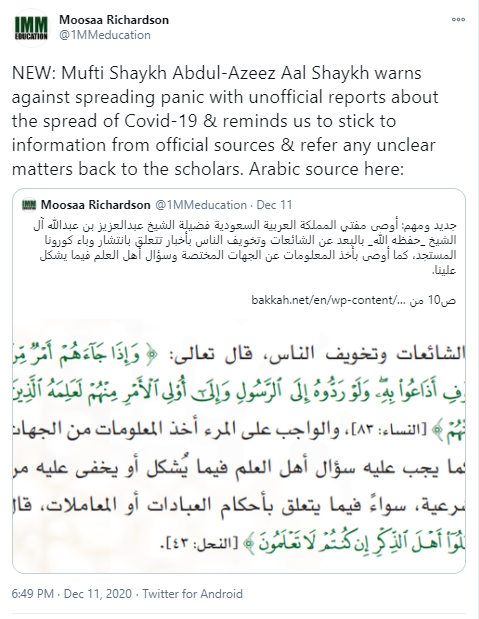
Source: Point #6 here https://www.bakkah.net/en/nine-advices-as-relates-the-novel-coronavirus-covid-19-pandemic-shaykh-abdul-azeez-aal-shaykh.htm
We have noticed a level of what appears to be an unhealthy obsession with Covid-19 conspiracy theories in many comments. We advise our readers to be fully aware of what the scholars of Islam are saying about this pandemic and the kinds of advice they are offering by reading the following:
**For these things, you may contact us privately.
Afwan akhee al kareem, i did not go through this before. I do have a question though. One that has been on my mind for sometime now. If i miss one of my rawaatab sunnah prayers, for example, the 4 before Dhuhr, maybe due to sleep or even delibrately sometimes, can i make them up after the time for Dhuhr has passed? My question thus encompasses all those Rawaatib sunnah prayers. BaarakAllaahu feek
إذا نسي أحدكم صلاة أونام عنها فليصلها إذا ذكرها
Meaning: “If one of you sleeps through a prayer or forgets it, then he is to pray it when he remembers it.” (Muslim, on the authority of Anas)
The wording of the hadeeth is general and thus includes non-obligatory prayers. For those who insist on it being specific to obligatory prayers, then by qiyaas (fah-wal-khitaab) – What has even more clear permissibility to be made up would be the non-obligatory prayers, and Allaah knows best.
JazaakAllaahu khayra akhee. But what about the other case the brother mentioned – when one misses the sunnah prayers deliberately?
Then he focuses on the upcoming prayers and their related nawaafil, asking Allaah for assistance. No repentance, regret, expiation, or replacement necessary for missed nawaafil, even the highly stressed ones. (Sorry for the delay.) And Allaah knows best.
Assalaamu alaykum
Is there a reason to why some comments aren’t replied to,while others are even though they adhere to the comment guidelines?I’m asking genuinely,so that I can abstain from disturbing the admins.BaarakAllaahu feekum
wa alaykis-salaamu wa rahmatullah,
We appreciate your patience and understanding. When we know the answer to your question or can help you somehow, we try to answer. Otherwise, the question remains for anyone who might be able to help you. Thank you for your question, and thank you for understanding.
As salamu alaykum, i have question about the permissibility of cutting the women’s hair. If a woman has damaged hair due to harsh chemicals and needs to cut it (maybe an inch or two from the ends) in order for it to become healthy and grow, is this permissible ?
Wa ‘alayk as-salaam. It is not forbidden for women to cut their hair. Our mother, ‘Aa’ishah (may Allaah be pleased with her), cut her hair to a ‘wafrah’ (short style). And Allaah knows best.
Jazakallahu khayr, i have another question regarding seeking knowledge….what is your advice for a woman who traveled to seek knowledge in egypt with two small children and a husband who also is seeking knowldege but wont allow her to leave the home to do so due to his personal fears?Meaning she can have a home tutor but cannot go to a markaz.
What is the ruling on contracts that contain Haram that one agrees to?
Is it Kufr due to the fact that it could be rejecting the fact that any contract that contains Haram is null and void? In addition, the fact that one agrees to be bound by something Haram?
One would be surprised at the number of things that include Haram contracts,
In brief, if the haraam thing is connected to the core of the contract, then the contract is invalid. An example would be the sale of intoxicants. If the haraam thing is a stipulation added to a valid contract, then the stipulation is invalid, while the contract itself remains valid. And Allaah knows best.
And just another thing, what about people who to try to enforce these Haram stipulations? Are they Kafirs?
Knowing them to be haraam and declaring them permissible would be outside of Islaam, while actions based on greed or oppression are sinful. And Allaah knows best.
As salaamu ‘alaykum wa rahmatullah, i have a brief question….is there any circumstance where it is permissible to make du’a against a believer ? If so, what are they ?
Salamu alayqum Moosa,
I’m from India, as you know here one famous personality in the name of Daawah running organisations,TV channel(peace),website(IRF). many people taking him as model in Dawah field, i mean his way of dressing,standing while addressing, speaking,studying bible, hindu religious books etc etc in methodology.
even those youth who ascribe to Ahlul-Hadeeth respect and follow him and say “he is Day’ee and doctor. who in india doing this type of Dawah in public? exposing their books ? debating with other religious leaders etc etc.
when i asked a common person about him, that Is he Mr. is an Aalim? where did he study? who are his Ulamaa? then furiously person start to reply saying that” yes he is kibar aalim, through his daawah the results are huge converting hundreds of kaafir to islam. is he Deviant?
what should i reply and how to refute ….
jazaakAllahu qairaa
Zakir Naik is not knowledgeable about Islam, he learned from and followed the way of Ahmad Deedat. Zakir is a person of rhetoric and philosophy, and I do not recommend anyone to listen to him. And Allaah knows best.
Abu Abbas you didn’t reply completely to my request…
what should i reply to the people even who ascribe themselves to Ahlul-Hadeeth jamaah?
who are kibar ulama of Ahlus sunnah in India? or Taalibul Ilm where i can refer back to?
Assalaamu Alaikumm Akhi Moosa,
May Allaah increase you in good and keep you strong… my question is regarding ruqya… is it permissible to perform ruqya over the phone? (e.g.; reciting the khuls, Surah Fatiha, Aayatul Kursi so on and so forth…) and is blowing after the recitation on the affected person is mandatory? if theres any other opinions please do guide me.
Barakallaahu feek…
Wassalaam
Aba Hanzalah (Sri Lanki)
wa alaykumussalaam. your answer is here:
https://abukhadeejah.com/ruqyah-by-telephone-facetime-zoom-skype-from-a-distance-is-futile-shaikh-fawzan/
from the website of Abu Khadeejah Abdul Wahid
Jazaak Allahu khayran.
I am shahadat from Bangladesh plz dier sir plz teel me whey my application modify page close? my application number ########
Please what did you know about the (translation of the script document) from english to arabic, which the applicant should do? Is it nacessary or not? Becouse i am in process.
please I studied Radio, TV, and Electronics Technology at the secondary school and I want to apply, will I get admission with it please?
السلام عليكم و رحمة الله و بركاته
May Allaah reward all you brothers who participate in the work to keep these sites like this up and running.
I have read this page in the past alhamdulillaah and I did send a couple a questions but they were never published – comments were published after that.
I don’t have a problem with the fact they weren’t published but I hope they were not offensive in any way and I apologize if that was so.
I love you brothers for the sake of Allaah… May Allaah keep me and you firm upon Salafiyyah until death.
Salamalikum
The questions are being vanished. Which place of your site they be allowed. We have to gain knowledge, need clarifications etc. we are far from you to reach you. Earlier a question on validity of a marriage is not answered even after over a month. So has happened with question on Sihr (for English Translation of Sheikh Muqbil (may Allah have mercy on him) ). Is your site only for reading. Can you recommend any other websites for quicker answers. No answers are disappointing, instills repulsive mood.
Wa ‘alayk as-salaamu wa rahmatullaah. I answer questions that are easy for me to answer, those which I can provide authentic information on and explain well. Due to my limited knowledge, the answers I can provide are few. May Allaah reward you for thinking well of your brother and being patient.
RE: Questions “vanishing” – then no, this does not happen. All questions need approved before they are published. You are the only one who sees your question until it is published. Some questions never get published, so maybe you refreshed your browser or dumped your cache, so the question then appears to have “vanished”.
Salamalaikum
Thank you , I got it. May Allaah keep you healthy and happy and increase you in knowledge and wisdom. Regarding my questions being vanished, yes I am using C cleaner app which is killing the cookies. My earlier reply is gone, on using it which confirms that bakkah admin is not to blame . So I am replying this again. Next i will use the C Cleaners after unchecking the cookies.
Assalam-o-Alykum,
on ur web-site system, all comments , and details are few years old,so I do nt know how to get the latest ones, I stay in South Africa and I need to contact
the top managemet incharge via-email,can you send me the email address,so
I can communicate,what I want to
As salaamu alaykum. Can you use a credit card that stipulates you have 2 yrs. before you have to pay interest?
Wa ‘alayk as-salaamu wa rahmatullaah. You are not allowed to enter an agreement wherein you voluntarily agree to pay an increase on the amount borrowed. That is clear ribaa (usury), and Allaah has made ribaa haraam and from the most destructive of all major sins. Debit cards (without overdraft coverage) use the money in your account, and this is permissible. Credit cards are not permissible, as they stipulate ribaa. Wallaahul-Muwaffiq.
Assalamu alaikum ustadh I was looking for an advice for salafis in cities which have no salafi masjids … barakallah feekum
السلام عليك و رحمة الله و بركاته
Yaa akhee May Allah give you good Aameen. I’ve been confused on this matter for some years concerning me fasting or feeding in Ramadhan. I have sickle cell disease which is not something that just goes away Wallahu ‘alim, but it doesn’t prevent me in strength or slow me down Walhamdulillaah. So should I fast or feed everyday?
بارك الله فيك
وعليكم السلام ورحمة الله وبركاته
The illness which allows you to break your fast is the one which adds difficulty to the fast. The illness which requires you to break your fast is one that directly leads to harm or death when you fast. And Allah knows best. So when you are ill with an illness that has no relevance to fasting, you still fast. And Allaah knows best.
Assalamu alaikum warahmathullahi wabarakathuhu
Is it allowed to teach children school rhymes and songs?
What is the ruling on coloring pictures like animals and living objects for school purpose?
Is it allowed to do zoom classes (video calling) and is it allowed to take pictures from page of the book which contains living objects?
Barak allahu feek
Wa ‘alaykum as-Salaamu wa rahmatullaahi wa barakaatuh. School rhymes that are without music but help the child learn important things, occasional innocent rhymes that are brief and helpful academically, no problem. As for all-out singing and music, or rhymes that become many in number and/or lengthy, then this is avoided. And Allah knows best.
You would benefit from this series, in shaa’ Allah. And the issue of images for children is discussed there in detail: https://www.spreaker.com/show/guidelines-for-parents-and-educators
Ustadh, can you mention some points which refute mawlid?
https://www.bakkah.net/en/wp-content/uploads/2018/11/A-Comprehensive-List-of-Companions-Who-Observed-Mowlid.pdf
As salaamu Alaykum brother Moosa
Please can you assist with my question.
I havw cancer and I’m confused on what to do in replace of fasting. I’m aware to feed the needy for each day missed.
However, I’m confused when it say needy person. Does this person have to be poor as in homeless? Or is someone who is “maybe less” fortunate sufficient?
Also, this needy person must be muslim or a non muslim is ok to feed to make up for the sick not fasting.
Must the days feeding the needy for the sick whom is unable to fast must it be during Ramadan only?
Barak Allahu feekum ustadah
Wa ‘alaykum as-Salaamu wa rahmatullaah. A poor person, to keep things easy, is someone who does not pay zakaat. Meaning: They do not have enough money to save anything over the year. Legislated acts of feeding the poor are intended to be the poor Muslims. And it can be done in Ramadhaan, day by day, or afterwards. Yet, I’d advise that you hasten to fulfill this duty, may Allah bless you and give you good health and comfort in this Dunyaa and joy in the Hereafter.
Allahumma Ameen
May Allaah Bless you Ameen!
Must it be as an iftar? Ex: I could only feed them if they have fasted for the day. Or could I feed a Muslim without them having been fasting that day. Ex: today Wednesday i could feed a family of lets say 5. Even though no one in the family of 5 will need to break fast today? I can just take them food.
Feeding a poor person can be done by providing iftaar to a fasting person (who is poor), or by feeding any poor person with a full meal at any occasion.
What advice can you give to a mother of young children who wishes to seek knowledge and maintain a good level of Eemaan however struggles and feels overwhelmed with her responsibilities and tiredness?
Also to a mother who is exhausted due to the needs of her children and the responsibilities of the home, how can she keep herself positive and not feel overwhelmed?
Jazakallaahu khayran
Any response would be much appreciated and something that could be shared with other mothers I know who go through the same feelings
She takes care of her most important and specific responsibilities first, and then uses whatever time and energy she finds to seek beneficial knowledge and essential reminders about her Religion. She asks Allah for His aid and assistance. May Allah bless her and grant her increased strength and patience. These are only a few days of hard work, and later the children you worked so hard for will be taking care of her, in shaa’ Allah, and she will have more “ME-time” to relax and focus on learning and benefiting. May Allah bless our sisters & mothers for how they tire themselves out for their families. May Allah honor them and give them success in this life and the Next!
Q: Some people say this: What is the ruling on people saying “I did it because I love you” referring to acts of pleasing your spouse through decorating oneself or wearing perfume and the like (if the other spouse jokingly asks about why one is being tempting) ? I know we must do it for the sake of Allaah, so is this statement impermissible? BarakAllahu feekum. .
It is permissible to say just “I love you” when the meaning is understood to be “for Allah’s sake.” The Prophet (may Allah raise his rank and grant him peace) said to Mu’aath ibn Jabal:
يا معاذ! والله إني لأحبك أوصيك يا معاذ لا تدعن في دبر كل صلاة أن تقول: اللهم أعني على ذكرك وشكرك وحسن عبادتك
“O Mu’aath! By Allah, I do indeed love you! I advise you not to leave off saying at the end of each prayer (after the prayer): O Allah, aid me in remembering You, thanking You, and worshipping You in a good way.”
Collected by Ahmad, Aboo Daawood, an-Nasaa’ee and others. Authenticated in Saheeh al-Jaami’ (7969)
And the following are some proofs that a Muslim spouse loves the others spouse for the sake of Allah:
1. They worship none but Allah together.
2. They establish prayers and remind each other about that.
3. They are married, not committing zinaa.
4. They do not obey each other’s whims to disobey Allah.
Most specifically, the woman in this question is doing things which Allah legislated to please her husband. So there is no reason to believe that her love for her husband is for other than the sake of Allah!
These are some proofs that their love is for the sake of Allah, whether they say it each time or not. And there are many more one could think of, so don’t let the Shaytaan trick you. And Allah knows best.
بارك الله فيكم. I recently went through your explanation of kitab tawheed and came across this section. “Doing acts of worship hoping for reward from Allah in worldly affairs” as being an act from the acts of shirk. And wallahi it’s left me with so many whispers and confusion for days. I hope you can clarify for me.
1.) how then do we reconcile the various evidences that encourage us to do deeds for earthly reward, eg “treat your sick with charity. Nabbi Nuh telling his people to seek forgiveness and Allah will reward them with rain, gardens etc. in Surah sajdah Allah mentioning “We shall cause them to face a nearer punishment (in the dunya)” so they may repent etc
2.) is the intention for Allah’s sake supposed to be absolute. ie we can’t hope for any good in the dunya along with the hope for the akhirah.
3. If it is shirk, to have intention for both. Is it absolute major shirk that renders one completely a mushrik or it renders that particular deed invalid. (Minor shirk) I guess.
1) I do not know the hadeeth, “Treat your sick with charity,” (داووا مرضاكم بالصدقة) to be authentic. As for Nooh calling his people to seek Allah’s Forgiveness and He (Allah) would reward them with rain, meaning he mentioned this as an incentive for them, this is from the angle of mentioning all the benefits of something collectively. This is similar to how we might mention from the benefits of fasting is self-control, or prayer helps you manage your time and schedule you day efficiently, etc. Mentioning the secondary (worldly) benefits of something for the Hereafter must not become the main drive of a person. Also, remember: Nooh tried each and every angle and approach to call his people. He left no stone unturned. Go back an re-read the entire Soorah (Soorah Nooh) and consider that important point of context carefully.
2) The drive, or intention, behind a Muslims’s deeds must be to gain the pleasure of Allah, to express servitude of Him, and to gain His protection from His punishment. Then, we also learn about the many great benefits of obedience as well, even the worldly ones. But whoever intends those things primarily, then he only gets those things from his worship. Consider the verse carefully:
من كان يريد العاجلة عجلنا له فيها ما نشاء لمن نريد ثم جعلنا له جهنم يصلاها مذموما مدحورا * ومن أراد الآخرة وسعى لها سعيها وهو مؤمن فأولئك كان سعيهم مشكورا
“Whoever intends this early life (this dunyaa), We shall bring him some of it early, in this life, for whomsoever We will. Then, We shall make Jahannam for him to enter, in disgrace and humiliation. But whoever intends the Hereafter and works for it, being a believer, such are those who shall have their work rewarded.” [17:18-19]
May Allah turn our hearts to the Hereafter and keep us busy seeking His Pleasure.
Assalam alaykoum dear Teacher,
Concerning the Hadith “Treat your sick with charity” (داووا مرضاكم بالصدقة). I found two refences, and one of them is reported as Hasan.
– Sahih al-Jami #3358: graded as Hasan by al-Albani. There is a comment on the Hadith: Abu Shaykh in al-Thawab, from Abi Oumama. Plus a reference to Silsila adh-Dha`ifa #3492.
– Silsila adh-Dha`ifa #3492: The hadith is longer, and “Treat your sick with charity” is a part of that longer hadith. Graded as Da`if Jidan (very weak). Several books on which the Hadith is reported are listed, and none of them is “al-Thawab of Abu Shaykh”.
I downloaded the PDF of the two books and saw them with my eyes. Can we conclude that there is an occurrence of the Hadith that is Hasan, (the one found in “al-Thawab of Abu Shaykh”)?
Assalaamu ‘Alaikum brother Mark and Moosaa,
Please see Shaykh Bin ‘Uthaymeen answering #2 of your question and in reality pretty much your entire question (less than 3 mins audio): https://binothaimeen.net/content/6126
It is very beneficial. He even talks about avoiding sins in order to avoid the punishment in this world.
Can someone please translate for Mark in case he does not understand the shaykh?
Wassalaam
Also another answer by the shaykh (may Allaah have mercy upon him) provide more clarification:
https://binothaimeen.net/content/3678
Even more:
My dear brother Mark, this one mentions the story of Nuh ‘alayhissalaam and it mentions the exact same verse you mentioned.
https://binothaimeen.net/content/4864
Question starts at 55 seconds in. It is a question that answers tour question especially the very last things he says along the lines of making your intention for the aakhirah more overpowering than the reward you also wish for in the dunya. And he explains previous to that, that If he has both intentions (dunya [to get what Nuh ‘alayhissalaam mentioned] and aakhirah) then it does not decrease his reward in anything and he says in previous audios I linked to, that, had having both intentions decrease the slave’s reward, then Allaah would not have mentioned it. He also says something very similar in this audio and gives more arguments, please listen to the audio.
Question starts at 55 seconds.
Before 0:55 you can listen to get the Shaykhs (I think) phone number back in the days for asking questions – I love this website, it’s as if I am with him in his gatherings. May Allaah have mercy upon him and reward him and his students (especially زين), those of them upon the straight path.
Also finally, for #3, the shaykh said it does not decrease his reward to have intention for both the dunya and aakhirah — so how can it be shirk!?
Leave these wasaawis and encourage yourself knowing that Allaah take care of his believing slaves and gives them reward in both the dunyaa and aakhirah. And make your hope for the aakhirah overpowering (following the advice of Shaykh ‘Uthaimeen) and don’t forget about it (the aakhirah) while also hoping and having Tawakkul that Allaah will take care of you in the dunyaa
Leave these wasaawis and encourage yourself knowing that Allaah take care of his believing slaves and gives them reward in both the dunyaa and aakhirah. See ayaat 146 to 148 of surah Aali ‘Imraan, the third surah. And make your hope for the aakhirah overpowering (following the advice of Shaykh ‘Uthaimeen) and don’t forget about it (the aakhirah) while also hoping and having Tawakkul that Allaah will take care of you in the dunyaa.
Wa Alaikum assalaam